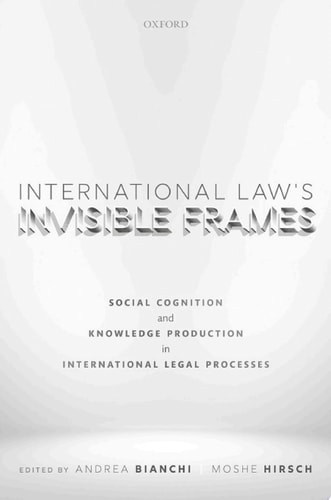
International Law's Invisible Frames: Social Cognition and Knowledge Production in International Legal Processes
0
0
As an Amazon Associate and affiliate partner, Menrva Books earns from qualifying purchases. Learn more
Author Description
What is international law, and how does it work? This book argues that our answers to these fundamental questions are shaped by a variety of social cognition and knowledge production processes. These processes act as invisible frames, through which we understand international law. To better conceive the frames within which international law moves and performs, we must understand how psychological and socio-cultural factors affect decision-making in an international legal process. This includes identifying the groups of people and institutions that shape and alter the prevailing discourse in international law, and unearthing the hidden meaning of the various mythologies that populate and influence our normative world. With chapters from leading experts in the discipline, employing insights from sociology, psychology, and behavioural science, this book investigates the mechanisms that allow us to apprehend and intellectually represent the social practice of international law. It unveils the hidden or unnoticed processes by which our understanding of international law is formed, and helps readers to unlearn some of the presuppositions that inform our largely unquestioned beliefs about international law.
Menrva's Summary
THE THESIS
This book investigates how social cognition and knowledge production processes function as invisible frames that shape our fundamental understanding of international law. The author, alongside a collection of leading experts, utilizes a multidisciplinary framework to examine the psychological and socio-cultural factors influencing decision-making within international legal institutions. By analyzing the groups and mythologies that dictate prevailing discourse, the text seeks to expose the hidden mechanisms that construct our normative reality.
THE SCOPE MAP
What You Will Find
- Analysis of psychological and behavioral science applications in legal decision-making
- Examination of socio-cultural factors in international legal processes
- Identification of institutional actors and discourse-shaping groups
- Deconstruction of mythologies influencing international legal norms
Scope Limits
- The text does not provide a comprehensive history of international law treaties
- It does not offer a practical manual for litigation or courtroom procedure
THE AUTHORITY PERSPECTIVE
Experts identify this work as a significant contribution to the sociology of international law, noting its departure from traditional doctrinal analysis. Readers frequently highlight the academic density of the prose, which requires a foundational understanding of legal theory and behavioral science to fully grasp the arguments presented.
Page Count:
330
Publication Date:
2021-01-01
Publisher:
OUP Oxford
ISBN-10:
0192663291
ISBN-13:
9780192663290
International Law
Sociology of Law
Professional Career & Trade
Behavioral Science
Legal Theory
Community Tags
Similar Books