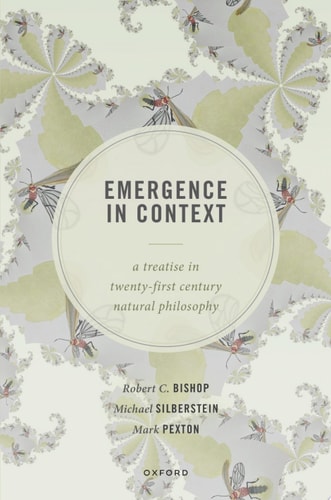
Emergence in Context: A Treatise in Twenty-First Century Natural Philosophy
0
0
As an Amazon Associate and affiliate partner, Menrva Books earns from qualifying purchases. Learn more
Author Description
Science, philosophy of science, and metaphysics have long been concerned with the question of how order, stability, and novelty are possible and how they happen. How can order come out of disorder? This book introduces a new account, contextual emergence, seeking to answer these questions. The authors offer an alternative picture of the world with an alternative account of how novelty and order arise, and how both are possible. Contextual emergence is grounded primarily in the sciences as opposed to logic or metaphysics. It is both an explanatory and ontological account of emergence that gets beyond the impasse between “weak” and “strong” emergence in the emergence debates. It challenges the “foundationalist” or hierarchical picture of reality and emphasizes the ontological and explanatory fundamentality of multiscale stability conditions and their contextual constraints, often operating globally over interconnected, interdependent, and interacting entities and their multiscale relations. It also focuses on the conditions that make the existence, stability, and persistence of emergent systems and their states and observables possible. These conditions and constraints are irreducibly multiscale relations, so it is not surprising that scientific explanation is often multiscale. Such multiscale conditions act as gatekeepers for systems to access modal possibilities (e.g., reducing or enhancing a system's degrees of freedom). Using examples from across the sciences, ranging from physics to biology to neuroscience and beyond, this book demonstrates that there is an empirically well-grounded, viable alternative to ontological reductionism coupled with explanatory anti-reductionism (weak emergence) and ontological disunity coupled with the impossibility of robust scientific explanation (strong emergence). Central metaphysics of science concerns are also addressed. Emergence in Context: A Treatise in Twenty-First Century Natural Philosophy is written primarily for philosophers of science, scientists, and metaphysicians.
Menrva's Summary
THE THESIS
This work investigates how order, stability, and novelty emerge within complex systems, proposing a new framework known as contextual emergence. The authors, including scholars in philosophy and physics, challenge traditional foundationalist hierarchies by arguing that multiscale stability conditions and contextual constraints are fundamental to reality. By grounding their account in scientific practice rather than pure logic, they seek to resolve the long-standing impasse between weak and strong emergence.
THE SCOPE MAP
What You Will Find
- A comprehensive framework for contextual emergence as both an explanatory and ontological account.
- Analysis of multiscale relations and their role as gatekeepers for modal possibilities.
- Cross-disciplinary case studies spanning physics, biology, and neuroscience.
- A critique of ontological reductionism and explanatory anti-reductionism.
Scope Limits
- The text does not provide a simplified introduction for laypeople, as it is written for an academic audience.
- It does not attempt to resolve every metaphysical debate, focusing instead on scientific grounding.
THE AUTHORITY PERSPECTIVE
Experts identify this text as a significant contribution to contemporary natural philosophy, particularly for its attempt to bridge the gap between scientific practice and metaphysical theory. Readers frequently note the academic density of the prose, which requires a strong background in philosophy of science to fully grasp the proposed multiscale framework.
Page Count:
512
Publication Date:
2022-01-01
Publisher:
OUP Oxford
ISBN-10:
0192666630
ISBN-13:
9780192666635
Philosophy
Science
Physics
Ontology
Metaphysics
Philosophy of
Community Tags
Similar Books










Reader Comments
Share Your Thoughts
No comments yet. Be the first to share your thoughts!