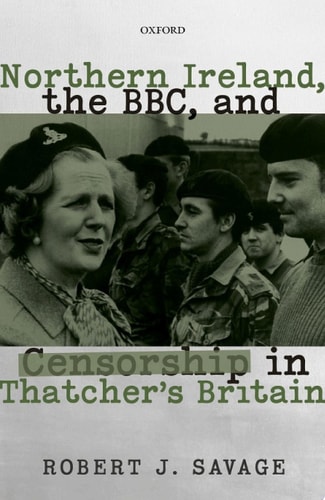
Northern Ireland, the BBC, and Censorship in Thatcher's Britain
0
0
As an Amazon Associate and affiliate partner, Menrva Books earns from qualifying purchases. Learn more
Author Description
This is a study of how the Northern Ireland conflict was presented to an increasingly global audience during the premiership of Britain's 'Iron Lady', Margaret Thatcher. It addresses the tensions that characterized the relationship between the broadcast media and the Thatcher Government throughout the 1980s. Robert J. Savage explores how that tension worked its way into decisions made by managers, editors, and reporters addressing a conflict that seemed insoluble. Margaret Thatcher mistrusted the broadcast media, especially the BBC, believing it had a left-wing bias that was hostile to her interests and policies. This was especially true of the broadcast media's reporting about Northern Ireland. She regarded investigative reporting that explored the roots of republican violence in the region or coverage critical of her government's initiatives as undermining the rule of law, and thereby providing terrorists with what she termed the 'oxygen of publicity'. She followed in the footsteps of the Labour Government that proceeded her by threatening and bullying both the BBC and IBA, promising that the draconian Prevention of Terrorism Act would be deployed to punish journalists that came into contact with the IRA. Although both networks continued to offer compelling news and current affairs programming, the tactics of her government produced considerable success. Wary of direct government intervention, both networks encouraged a remarkable degree of self-censorship when addressing 'the Troubles'. Regardless, by 1988, the Thatcher Government, unhappy with criticism of its policies, took the extraordinary step of imposing formal censorship on the British broadcast media. The infamous 'broadcasting ban' lasted six years, successfully silencing the voices of Irish republicans while tarnishing the reputation of the United Kingdom as a leading global democracy.
Menrva's Summary
THE THESIS
This book investigates the complex and often adversarial relationship between the British government under Margaret Thatcher and the broadcast media regarding the reporting of the Northern Ireland conflict. Robert J. Savage, a historian specializing in modern British and Irish history, utilizes archival research and internal broadcast records to analyze how political pressure influenced editorial decision-making. The work argues that the Thatcher administration’s hostility toward the BBC and IBA led to a climate of self-censorship, culminating in the formal broadcasting ban of 1988.
THE SCOPE MAP
What You Will Find
- Analysis of the 1980s political climate in Britain and its impact on news production.
- Examination of the 'oxygen of publicity' doctrine and its application to media policy.
- Documentation of the transition from informal government pressure to the formal 1988 broadcasting ban.
Scope Limits
- The study focuses primarily on the relationship between the British government and national broadcasters rather than the internal operations of Irish media outlets.
- The analysis does not provide an exhaustive military history of the Troubles, focusing instead on the media representation of the conflict.
THE AUTHORITY PERSPECTIVE
Scholars and media historians frequently cite this work as a definitive account of state-media relations during the Thatcher era. Readers often note the academic rigor and the detailed use of primary source documents to illustrate the erosion of editorial independence.
Page Count:
200
Publication Date:
2022-01-01
Publisher:
OUP Oxford
ISBN-10:
0192666584
ISBN-13:
9780192666581
History
Modern History
Media Studies
Journalism
Northern Ireland
British History
Community Tags
Other Editions(2)

Similar Books
Reader Comments
Share Your Thoughts
No comments yet. Be the first to share your thoughts!