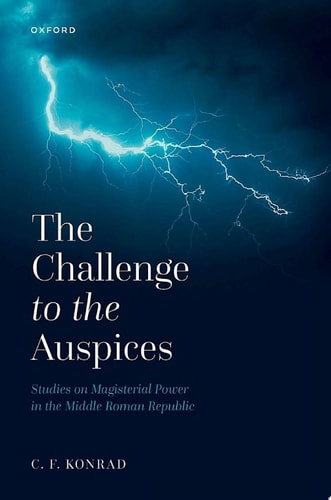
The Challenge to the Auspices: Studies on Magisterial Power in the Middle Roman Republic
0
0
As an Amazon Associate and affiliate partner, Menrva Books earns from qualifying purchases. Learn more
Author Description
No public action of the Roman state, the populus Romanus, at home or at war, was to be carried out without prior permission from Iuppiter Optimus Maximus. Permission was obtained, in a procedure known as auspices, by the magistrate in charge of the intended action-usually a Consul, Praetor, or Dictator. Auspices thus occupy a fundamental place in the-unwritten-constitution of the Roman State. Yet especially in the 3rd century BCE, acceptance of the principle was not always universal. The Challenge to the Auspices presents an investigation into the interaction of Roman magistrates during the Middle Republic with the practice of auspices, with a focus on attempts to avoid, ignore, or resist this requirement. Proceeding from an examination of the Roman concepts of imperium and auspices (auspicia), especially as they relate to the realm of war, and of the constitutional position and powers of the Dictator and the Master-of-Horse (magister equitum) relative to each other and to the Consuls and lower magistrates, the work offers six case studies in which Roman commanders questioned, violated, or openly rejected the need for auspices. It is argued that these instances reflect a not insignificant minority view within the Roman ruling class regarding the efficacy of auspices and the necessity of observing them. The catastrophic outcome in several of these events, particularly during the early years of the Second Punic War, rendered further resistance to the practice politically unsustainable, and by the second century resulted in its universal acceptance, regardless of personal belief.
Menrva's Summary
THE THESIS
This work investigates the tension between the Roman constitutional requirement of auspices and the practical resistance to this religious mandate by magistrates during the Middle Roman Republic. C. F. Konrad, a scholar of Roman history, utilizes primary source analysis to examine how Roman commanders navigated the intersection of imperium and religious obligation. The author argues that resistance to the auspices was a recurring, albeit minority, phenomenon among the ruling class, which was only suppressed after the political fallout of military failures during the Second Punic War.
THE SCOPE MAP
What You Will Find
- Analysis of the constitutional relationship between Consuls, Praetors, Dictators, and the Master-of-Horse.
- Six detailed case studies of Roman commanders who challenged or bypassed the auspicial process.
- Examination of the Roman concepts of imperium and auspicia within the context of military command.
Scope Limits
- The study focuses primarily on the 3rd century BCE and does not provide an exhaustive history of Roman religious practice beyond the context of magisterial power.
THE AUTHORITY PERSPECTIVE
Scholars recognize this text as a specialized contribution to the study of Roman constitutional history and the intersection of religion and politics. Readers frequently note the academic density of the prose, which is intended for those with a background in Roman law and history.
Page Count:
362
Publication Date:
2022-01-01
Publisher:
OUP Oxford
ISBN-10:
0192668064
ISBN-13:
9780192668066
History
Ancient - Rome
Ancient History
Military History
Community Tags
Similar Books