Quasibrittle Fracture Mechanics and Size Effect: A First Course
0
0
As an Amazon Associate and affiliate partner, Menrva Books earns from qualifying purchases. Learn more
Author Description
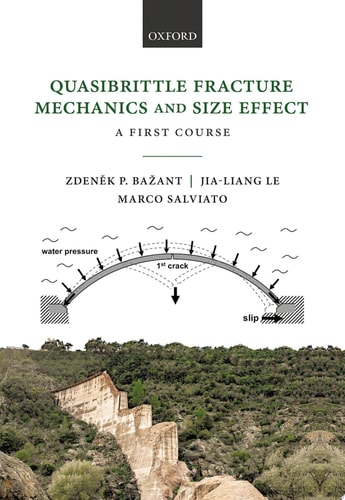
Many modern engineering structures are composed of brittle heterogenous, or quasibrittle, materials. These include concrete, composites, tough ceramics, rocks, cold asphalt mixtures, and many brittle materials at the microscale. Understanding the failure behavior of these materials is of paramount importance for improving the resilience and sustainability of various engineering structures including civil infrastructure, aircraft, ships, military armors, and microelectronic devices. Designed for graduate and upper-level undergraduate university courses, this textbook provides a comprehensive treatment of quasibrittle fracture mechanics. It includes a concise but rigorous examination of linear elastic fracture mechanics, which is the foundation of all fracture mechanics. It also covers the fundamental concepts of nonlinear fracture mechanics, and introduces more advanced concepts such as triaxial stress state in the fracture process zone, nonlocal continuum models, and discrete computational models. Finally, the book features extensive discussion of the various practical applications of quasibrittle fracture mechanics across different structures and engineering disciplines, and throughout includes exercises and problems for students to test their understanding.
Menrva's Summary
THE THESIS
How can engineers accurately predict the failure behavior of quasibrittle materials in complex structural applications? The authors, led by Zdenek P. Bažant, a prominent figure in the field of mechanics, utilize a combination of classical linear elastic fracture mechanics and advanced nonlinear models to address the size effect in heterogeneous materials. The text provides a rigorous framework for understanding how materials like concrete, rock, and composites behave under stress, bridging the gap between theoretical mechanics and practical engineering design.
THE SCOPE MAP
What You Will Find
- Comprehensive coverage of linear elastic fracture mechanics as a foundational baseline.
- Advanced analysis of nonlinear fracture mechanics, including triaxial stress states and the fracture process zone.
- Introduction to nonlocal continuum models and discrete computational methods for material failure.
- Practical application case studies across civil, aerospace, and microelectronic engineering disciplines.
Scope Limits
- The text focuses primarily on quasibrittle materials and does not provide an exhaustive survey of ductile metal fracture mechanics.
- It assumes a prerequisite knowledge of undergraduate-level solid mechanics and mathematics.
THE AUTHORITY PERSPECTIVE
Experts recognize this work as a definitive pedagogical resource for graduate students and researchers specializing in structural integrity. Readers frequently note the technical density of the prose, which requires a strong background in continuum mechanics to fully grasp the presented models.
Page Count:
224
Publication Date:
2021-01-01
Publisher:
OUP Oxford
ISBN-10:
0192661388
ISBN-13:
9780192661388
Fracture mechanics
Structural Engineering
Engineering
textbook
Earth Sciences
Community Tags
Similar Books