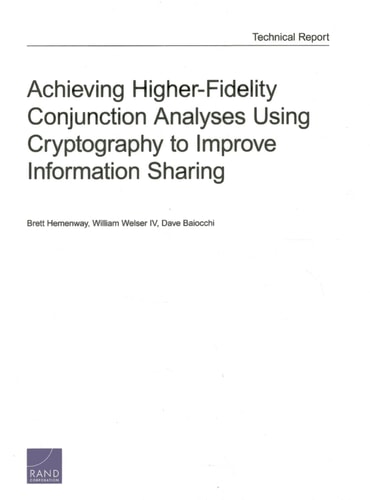
Achieving Higher-Fidelity Conjunction Analyses Using Cryptography to Improve Information Sharing
0
0
As an Amazon Associate and affiliate partner, Menrva Books earns from qualifying purchases. Learn more
Author Description
Space debris—the man-made orbital junk that represents a collision risk to operational satellites—is a growing threat that will increasingly affect future space-related mission designs and operations. Since 2007, the number of orbiting debris objects has increased by over 40 percent as a result of the 2007 Chinese antisatellite weapon test and the Iridium/Cosmos collision in 2009. With this sudden increase in debris, there is a renewed interest in reducing future debris populations using political and technical means. The 2010 U.S. Space Policy makes several policy recommendations for addressing the space congestion problem. One of the policy’s key suggestions instructs U.S. government agencies to promote the sharing of satellite positional data, as this can be used to predict (and avoid) potential collisions. This type of information is referred to as space situational awareness (SSA) data, and, traditionally, it has been treated as proprietary or sensitive by the organizations that keep track of it because it could be used to reveal potential satellite vulnerabilities. This document examines the feasibility of using modern cryptographic tools to improve SSA. Specifically, this document examines the applicability and feasibility of using cryptographically secure multiparty computation (MPC) protocols to securely compute the collision probability between two satellites. These calculations are known as conjunction analyses. MPC protocols currently exist in the cryptographic literature and would provide satellite operators with a means of computing conjunction analyses while maintaining the privacy of each operator’s orbital information.
Menrva's Summary
THE THESIS
This document investigates the feasibility of employing cryptographic techniques to enhance space situational awareness (SSA) and facilitate secure information sharing regarding satellite positional data. The growing threat of space debris necessitates improved methods for predicting and avoiding collisions. Traditionally, SSA data has been treated as proprietary due to its potential to reveal satellite vulnerabilities. This paper specifically examines the application of cryptographically secure multiparty computation (MPC) protocols to perform conjunction analyses, calculating collision probabilities between satellites while preserving the privacy of individual orbital information.
THE SCOPE MAP
- An examination of the growing threat posed by space debris and its impact on future space missions.
- An analysis of the policy recommendations for addressing space congestion, particularly the promotion of satellite positional data sharing.
- A detailed look at the challenges associated with sharing sensitive SSA data due to potential revelations of satellite vulnerabilities.
- An exploration of modern cryptographic tools, specifically cryptographically secure multiparty computation (MPC) protocols.
- An assessment of the applicability and feasibility of using MPC for conjunction analyses.
- A discussion on how MPC protocols can enable satellite operators to compute collision probabilities while maintaining the privacy of their orbital information.
THE AUTHORITY PERSPECTIVE
This work addresses a critical and evolving challenge in space operations: the management of space debris and the secure sharing of vital situational awareness data. The document's focus on cryptographic solutions, particularly multiparty computation, indicates a technical and forward-looking approach to a problem with significant policy implications. By exploring the feasibility of these advanced techniques, the paper aims to provide a pathway for more robust and secure methods of collision avoidance in orbit. The research presented is likely to be of interest to those involved in space policy, satellite operations, and cryptographic applications.
Page Count:
45
Publication Date:
2014-01-01
Publisher:
Rand Corporation
ISBN-10:
0833081667
ISBN-13:
9780833081667
Non-Fiction
Science
Cryptography
Community Tags
Similar Books