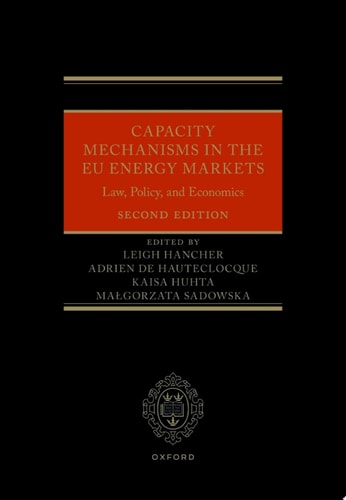
Capacity Mechanisms in the EU Energy Markets: Law, Policy, and Economics
0
0
As an Amazon Associate and affiliate partner, Menrva Books earns from qualifying purchases. Learn more
Author Description
Capacity remuneration mechanisms (or simply capacity mechanisms) have become a fact of life in member states' energy markets and are one of the hottest topics in the wider European regulatory debate. Concerned about the security of electricity supply, national governments are implementing subsidy schemes to encourage investment in conventional power generation capacity, alongside already heavily subsidized renewable energy sources. With the increasingly connected European electricity markets, the introduction of a capacity mechanism in one country not only tends to distort its national market but may also have unforeseeable consequences for neighbouring electricity markets. As these mechanisms are adopted by member states with limited supra-national coordination as well as consideration for the cross-border impact, they tend to cause serious market distortions and put the future of the European internal electricity market at risk.This second edition will take stock of how capacity mechanisms have actually worked so far and consider the consequences they have for the European internal electricity market. It will include a detailed overview of national capacity mechanisms, their implications for the EU internal market, and will outline the nature of market failures which are likely to occur in the European electricity markets. This edition is intended to serve as a point of reference for regulators and policy-makers on how to design optimal capacity mechanisms in Europe. It will be an invaluable resource for anyone interested in energy market design, regulation, and competition issues.
Menrva's Summary
THE THESIS
This book investigates the regulatory, legal, and economic challenges posed by the implementation of national capacity remuneration mechanisms within the integrated European electricity market. The authors, a team of legal and energy policy experts, analyze how individual state subsidies for power generation interact with broader EU market objectives. By evaluating the tension between national security of supply and supra-national market cohesion, the text provides a framework for understanding the distortions caused by uncoordinated energy policies.
THE SCOPE MAP
What You Will Find
- Comparative analysis of national capacity mechanism designs across EU member states
- Legal assessment of state aid rules and competition law in the energy sector
- Economic modeling of market failures and cross-border externalities
- Regulatory recommendations for optimizing future energy market design
Scope Limits
- Does not provide a comprehensive technical manual for power plant engineering
- Excludes detailed political histories of individual member state energy ministries
THE AUTHORITY PERSPECTIVE
Experts identify this text as a primary reference for regulators and legal practitioners navigating the complexities of European energy policy. Readers frequently note the academic density of the prose, which is tailored specifically for professionals involved in energy market design and competition law.
Page Count:
502
Publication Date:
2022-01-01
Publisher:
OUP Oxford
ISBN-10:
0192666673
ISBN-13:
9780192666673
Economics
Energy Law
Professional Career & Trade
European Union
Regulation
Public Policy
Electricity Markets
Community Tags
Similar Books