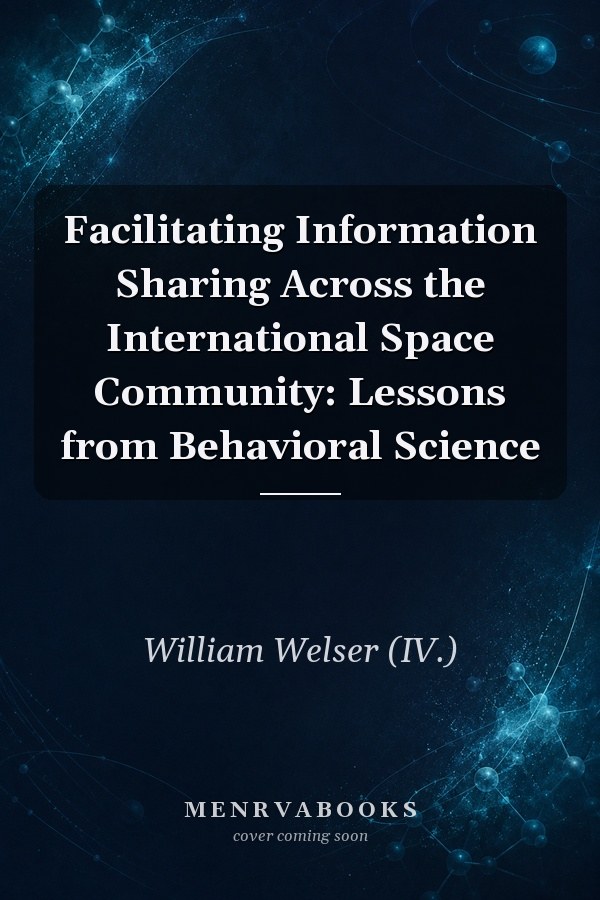
Facilitating Information Sharing Across the International Space Community: Lessons from Behavioral Sciences
0
0
As an Amazon Associate and affiliate partner, Menrva Books earns from qualifying purchases. Learn more
Author Description
An increasing number of countries and organizations have realized the advantages of space-based assets. A handful of countries can launch their own unmanned orbital missions, while others have relied on partnerships with other countries to launch their payloads. In addition, private companies are working to provide the public and private sectors with additional spacelift capacity. Increasing space activities, however, have also increased both the number of operational satellites and the amount of space debris. The latter, in particular, has renewed interest among such entities as the U.S. military and private spaceflight companies in reducing future debris populations using political and technical means. But doing this effectively requires these diverse space organizations to share information that has traditionally been treated as proprietary or sensitive. This report examines some of the behavioral and psychological barriers that may prevent diverse entities from sharing data and processes more freely and suggests ways the U.S. Air Force might be able to overcome them to encourage the information sharing that will help the community as a whole address the growing space congestion problem.
Menrva's Summary
THE THESIS
This report investigates the behavioral and psychological barriers hindering information sharing within the international space community and proposes solutions for the U.S. Air Force. The increasing reliance on space-based assets by numerous countries and private companies has led to a surge in space activities, consequently increasing both operational satellites and space debris. Effectively managing this congestion, particularly reducing future debris, necessitates that diverse organizations share traditionally proprietary or sensitive data. The authors examine the psychological and behavioral obstacles to this free exchange of information and suggest strategies for the U.S. Air Force to overcome them, thereby fostering community-wide cooperation to address the growing space congestion problem.
THE SCOPE MAP
- Analysis of behavioral and psychological barriers to information sharing in the space sector.
- Examination of the advantages of space-based assets and the implications of increasing space activities.
- Discussion of the growing problem of space debris and its impact on operational satellites.
- Strategies for the U.S. Air Force to encourage information sharing among diverse space organizations.
- Focus on overcoming proprietary and sensitive data concerns.
- Exploration of political and technical means to reduce future space debris populations.
- Insights into partnerships between countries for space launches and private sector involvement in spacelift capacity.
THE AUTHORITY PERSPECTIVE
This report is positioned as a strategic analysis for the U.S. Air Force, drawing on behavioral sciences to address a critical issue in space operations. The subject matter suggests a focus on policy, international cooperation, and the practical challenges of managing shared resources in orbit. The authors' approach, grounded in behavioral and psychological principles, indicates an effort to provide actionable insights for improving inter-organizational communication and collaboration in a complex, evolving domain. The report aims to contribute to the broader effort of mitigating space congestion and ensuring the sustainable use of outer space.
Page Count:
20
Publication Date:
2013-01-01
Publisher:
RAND
ISBN-10:
0833076949
ISBN-13:
9780833076946
Science
Non-Fiction
Behavioral Science
Policy
Aerospace
International relations
Community Tags
Similar Books