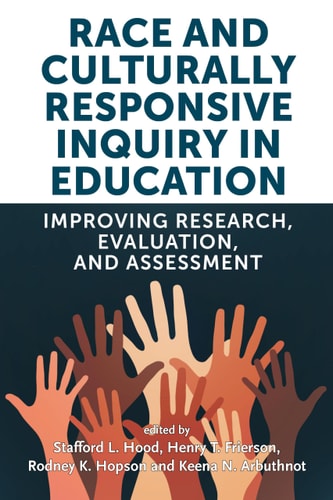
Race and Culturally Responsive Inquiry in Education: Improving Research, Evaluation, and Assessment
0
0
As an Amazon Associate and affiliate partner, Menrva Books earns from qualifying purchases. Learn more
Author Description
Race and Culturally Responsive Inquiry in Education examines how assumptions about race and culture have shaped US education research and the interpretation and implementation of its results. This volume sheds light on the detrimental effects of educational praxis and policies that have characterized communities of color and underserved communities as deficient. Featuring contributions from leading and emerging scholars, the collection is organized around three key areas--education research, educational assessment, and program evaluation. The contributors suggest compelling solutions for consideration by policy makers and practitioners as well as researchers. "This volume could not come at a more propitious time. Its value lies in confronting the contradictions and inadequacies of social welfare systems' policies and practices that are culturally relevant to the populations they purport to serve." --Carol Camp Yeakey, Marshall S. Snow Professor of Arts and Sciences, Washington University in St. Louis "This brilliant book shows how theoretically rich, empirically rigorous, equity-based educational perspectives, practices, and policies can help to reclaim the soul of the nation." --Walter R. Allen, Allan Murray Cartter Professor of Higher Education, University of California, Los Angeles Stafford L. Hood is the founding director of the Center for Culturally Responsive Evaluation and Assessment. Henry T. Frierson is a professor of education at the University of Florida. Rodney K. Hopson is a professor of evaluation at the University of Illinois Urbana-Champaign. Keena N. Arbuthnot is the Joan Pender McManus Distinguished Professor of Education at Louisiana State University. H. Richard Milner IV is Cornelius Vanderbilt Distinguished Professor of Education at Vanderbilt University. He is President as well as a Fellow of the American Educational Research Association, an elected member of the National Academy
Menrva's Summary
THE THESIS
This book investigates the pervasive influence of race and cultural assumptions on the landscape of education research, evaluation, and assessment in the United States. It critically examines how these ingrained biases have historically shaped educational practices and policy, often leading to the mischaracterization of minority and underserved communities as deficient. The volume brings together leading scholars to propose concrete solutions and frameworks for more equitable and culturally responsive approaches in research, assessment, and program evaluation.
THE SCOPE MAP
- Analysis of how race and cultural assumptions have historically shaped US education research.
- Examination of the detrimental effects of educational praxis and policies on communities of color and underserved communities.
- Contributions focused on education research methodologies.
- Contributions focused on educational assessment practices.
- Contributions focused on program evaluation frameworks.
- Presentation of compelling solutions for policymakers, practitioners, and researchers.
- Discussion of culturally relevant and equity-based educational perspectives and policies.
THE AUTHORITY PERSPECTIVE
This volume is recognized for its timely and critical examination of race and culture in education research. It is lauded for confronting the inadequacies of social welfare systems and policies that fail to be culturally relevant to the populations they serve. The book is seen as a significant contribution, offering theoretically rich and empirically rigorous perspectives that can help reshape educational practices and policies toward greater equity. Its insights are considered valuable for researchers, practitioners, and policymakers alike.
Page Count:
256
Publication Date:
2022-01-01
Publisher:
Harvard Education Press
ISBN-10:
1682537536
ISBN-13:
9781682537534
History
Non-Fiction
Politics
Sociology
Research Methods
Education
Community Tags
Similar Books


Reader Comments
Share Your Thoughts
No comments yet. Be the first to share your thoughts!