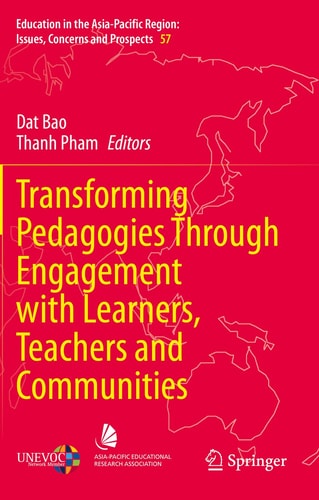
Transforming Pedagogies Through Engagement with Learners, Teachers and Communities
0
0
As an Amazon Associate and affiliate partner, Menrva Books earns from qualifying purchases. Learn more
Author Description
This book identifies three types of influential forces that pose challenges to innovations: socio-cultural dynamics, teacher individuality, and local circumstances. It uses languages, cultural traits, and intellectual heritages in the Asia-Pacific region as an example to show the resistance to Western-based pedagogies due to disparities between the innovations and these local heritages. It reveals personal and professional values that teachers hold and how these values, while seemingly supporting creative ideologies, happen to prevent them from incorporating innovations in their practices. The book discusses how informal educational activities and services that a society possesses could impede pedagogical innovations. There is, therefore, a need for institutions and educators to develop a positive relationship between these phenomena and teaching innovations.
Menrva's Summary
THE THESIS
This book investigates the complex interplay between pedagogical innovation and the deeply ingrained forces that resist its adoption. It examines how socio-cultural dynamics, individual teacher values, and specific local circumstances create barriers to implementing new teaching methods. Using the Asia-Pacific region as a case study, the authors demonstrate how Western-based pedagogies often clash with local cultural heritages and intellectual traditions, leading to resistance. The work further explores how teachers' personal and professional values, even when seemingly aligned with progressive ideologies, can inadvertently hinder innovation, and how informal educational structures within a society can impede pedagogical advancements, highlighting the necessity for institutions and educators to foster a positive relationship between these elements and teaching innovations.
THE SCOPE MAP
- Analysis of socio-cultural dynamics as a force influencing pedagogical change.
- Examination of teacher individuality and its impact on the adoption of innovations.
- Exploration of local circumstances and their role in resisting pedagogical shifts.
- Case study focusing on the Asia-Pacific region to illustrate resistance to Western-based pedagogies.
- Discussion on the conflict between Western pedagogical models and local cultural heritages.
- Investigation into how teachers' personal and professional values affect innovation implementation.
- Analysis of informal educational activities and services as potential impediments to innovation.
- Recommendations for developing positive relationships between societal factors and teaching innovations.
THE AUTHORITY PERSPECTIVE
The book addresses the critical challenges faced by educational innovators, particularly in diverse cultural contexts like the Asia-Pacific region. It highlights the nuanced reasons behind the resistance to pedagogical change, stemming from socio-cultural factors, individual teacher beliefs, and local conditions. The authors' examination of how established values and informal educational structures can impede progress offers a valuable perspective for educators and institutions seeking to implement new teaching methods effectively. The work underscores the need for a more integrated approach that respects local heritages while fostering innovation.
Page Count:
255
Publication Date:
2022-06-14
Publisher:
Springer Nature Singapore
ISBN-10:
9811600597
ISBN-13:
9789811600593
Non-Fiction
Education
Sociology
Pedagogy
Community Tags
Similar Books