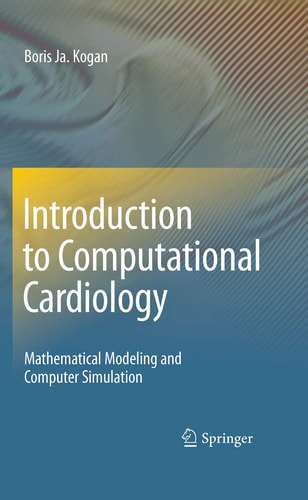
Introduction to Computational Cardiology: Mathematical Modeling and Computer Simulation
0
0
As an Amazon Associate and affiliate partner, Menrva Books earns from qualifying purchases. Learn more
Author Description
Introduction to Computational Cardiology provides a comprehensive, in-depth treatment of the fundamental concepts and research challenges involved in the mathematical modeling and computer simulation of dynamical processes in the heart, under normal and pathological conditions. This book is based on the author's lecture notes from his course 'Introduction to Computational Cardiology' in the Department of Computer Science within the University of California, Los Angeles. It also encompasses the scientific discoveries made by the author, his doctoral students, and his colleagues in the U.S.A. and U.S.S.R. in the last 35 years. Several features of this textbook are listed below: - A description of models used in both biology and medicine for discovering the mechanisms of heart function and dysfunction on several physiological scales across different species. - An introduction to the theory of stationary reentrant wave propagation in one- and two-dimensional tissues. - Several examples throughout this textbook and exercises at the end which facilitate understanding of basic concepts and introduces, for implementation, treated problems to parallel supercomputers. Introduction to Computational Cardiology serves as a secondary textbook or reference book for advanced-level students in computer science, electrical engineering, biomedical engineering, and cardiac electrophysiology. It is also suitable for researchers employing mathematical modeling and computer simulations of biomedical problems.
Menrva's Summary
THE THESIS
This book investigates the complex dynamical processes of the heart through mathematical modeling and computer simulation. Boris Ja Kogan's Introduction to Computational Cardiology offers a deep dive into the methodologies and challenges of simulating cardiac function, both in healthy and diseased states. Drawing from his extensive teaching experience at UCLA and decades of research with colleagues in the US and USSR, Kogan presents models used across species to uncover the mechanisms of heart function and dysfunction. The text introduces the theory of reentrant wave propagation and provides practical examples and exercises designed for implementation on parallel supercomputers, making it a valuable resource for advanced students and researchers.
THE SCOPE MAP
- Models used in biology and medicine to discover mechanisms of heart function and dysfunction across physiological scales and species.
- An introduction to the theory of stationary reentrant wave propagation in one
- and two-dimensional tissues.
- Practical examples and exercises designed for understanding basic concepts and implementation on parallel supercomputers.
- Coverage of dynamical processes in the heart under normal and pathological conditions.
- Insights from 35 years of scientific discoveries by the author and his collaborators.
THE AUTHORITY PERSPECTIVE
The book is positioned as a secondary textbook or reference for advanced students in computer science, electrical engineering, biomedical engineering, and cardiac electrophysiology, as well as for researchers in biomedical modeling. Its comprehensive treatment of fundamental concepts and research challenges, coupled with practical examples and exercises, suggests it aims to equip readers with the theoretical knowledge and computational skills necessary for advancing the field of computational cardiology. The inclusion of the author's own research and that of his colleagues indicates a focus on established and novel findings within the discipline.
Page Count:
231
Publication Date:
2014-09-03
Publisher:
Springer US
ISBN-10:
1489985034
ISBN-13:
9781489985033
Non-Fiction
Science
Cardiology
Biomedical Engineering
Mathematical Modeling
Community Tags
Similar Books