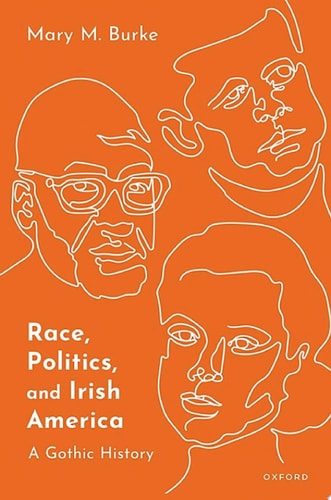
Race, Politics, and Irish America: A Gothic History
0
0
As an Amazon Associate and affiliate partner, Menrva Books earns from qualifying purchases. Learn more
Author Description
Figures from the Scots-Irish Andrew Jackson to the Caribbean-Irish Rihanna, as well as literature, film, caricature, and beauty discourse, convey how the Irish racially transformed multiple times: in the slave-holding Caribbean, on America's frontiers and antebellum plantations, and along its eastern seaboard. This cultural history of race and centuries of Irishness in the Americas examines the forcibly transported Irish, the eighteenth-century Presbyterian Ulster-Scots, and post-1845 Famine immigrants. Their racial transformations are indicated by the designations they acquired in the Americas: 'Redlegs,' 'Scots-Irish,' and 'black Irish.' In literature by Fitzgerald, O'Neill, Mitchell, Glasgow, and Yerby (an African-American author of Scots-Irish heritage), the Irish are both colluders and victims within America's racial structure. Depictions range from Irish encounters with Native and African Americans to competition within America's immigrant hierarchy between 'Saxon' Scots-Irish and 'Celtic' Irish Catholic. Irish-connected presidents feature, but attention to queer and multiracial authors, public women, beauty professionals, and performers complicates the 'Irish whitening' narrative. Thus, 'Irish Princess' Grace Kelly's globally-broadcast ascent to royalty paves the way for 'America's royals,' the Kennedys. The presidencies of the Scots-Irish Jackson and Catholic-Irish Kennedy signalled their respective cohorts' assimilation. Since Gothic literature particularly expresses the complicity that attaining power ('whiteness') entails, subgenres named 'Scots-Irish Gothic' and 'Kennedy Gothic' are identified: in Gothic by Brown, Poe, James, Faulkner, and Welty, the violence of the colonial Irish motherland is visited upon marginalized Americans, including, sometimes, other Irish groupings. History is Gothic in Irish-American narrative because the undead Irish past replays within America's contexts of race.
Menrva's Summary
THE THESIS
This work investigates how the Irish in America navigated and transformed their racial identity through centuries of social, political, and literary evolution. Mary M. Burke, a scholar of Irish literature and culture, utilizes a multidisciplinary approach to analyze how Irish populations transitioned from marginalized groups to participants in American power structures. The author argues that this process of 'whitening' is inherently linked to the Gothic mode, where historical trauma and colonial violence are replayed within the American racial hierarchy.
THE SCOPE MAP
What You Will Find
- Analysis of racial designations including 'Redlegs,' 'Scots-Irish,' and 'black Irish.'
- Examination of literary works by authors such as Fitzgerald, O'Neill, Faulkner, and Welty.
- Exploration of the 'Scots-Irish Gothic' and 'Kennedy Gothic' subgenres.
- Historical overview of Irish experiences from the Caribbean to the American frontier.
Scope Limits
- The text does not provide a comprehensive biography of every Irish-American political figure mentioned.
- It does not offer a general history of Ireland, focusing instead on the specific context of the Irish diaspora in the Americas.
THE AUTHORITY PERSPECTIVE
Scholars and critics recognize this text as a sophisticated contribution to the study of the Irish diaspora and racial formation in the United States. Readers frequently note the academic density of the prose and the innovative application of Gothic literary theory to historical analysis.
Page Count:
472
Publication Date:
2022-01-01
Publisher:
OUP Oxford
ISBN-10:
0192675842
ISBN-13:
9780192675842
History
Fairy Tales
Sociology
Literary Criticism
American Studies
Race Relations
Community Tags
Similar Books