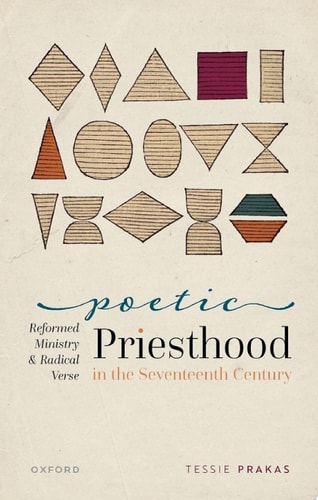
Poetic Priesthood in the Seventeenth Century: Reformed Ministry and Radical Verse
0
0
As an Amazon Associate and affiliate partner, Menrva Books earns from qualifying purchases. Learn more
Author Description
Poetic Priesthood reads seventeenth-century devotional verse as staging a surprising competition between poetry and the established church. The work of John Donne, George Herbert, Richard Crashaw, John Milton, and Thomas Traherne suggests that the demands of faith are better understood by poets than by priests--even while four of these authors were also ordained. While recent scholarship has tended to emphasize the shaping influence of the liturgy on the poetry of this period, this book argues that verse instead presents readers with a mode of articulating piety that relies on formal experimentation, and that varies from the forms of the church rather than straightforwardly reproducing them. In crafting this poetic aid to devotion, these authors practiced an alternative and even more ample form of ministry than in their ecclesiastical activities. In the wake of the Reformation, the liturgy of the English church centered on rituals of communal prayer and praise, but the poetry considered in this study suggests that such rituals in fact risk distracting worshippers from the pleasures and challenges of navigating an individual relationship with God. Yet these poets do not make this suggestion by rejecting communal rituals outright. Their verse invokes ecclesiastical practice as a basis for formal innovation that suggests how intimacy with the divine might look, feel, and sound, connecting humans with their God more precisely and more individually than the liturgy can. As they shift between explicit comment on the liturgy and more subtle departures from it in the interplay of verse form and denotation, these authors claim the work of priesthood for poetry.
Menrva's Summary
THE THESIS
This book investigates the tension between seventeenth-century liturgical practice and the devotional verse of major poets, arguing that poetry functioned as an alternative, more individualized form of priesthood. Tessie Prakas, a scholar of early modern literature, utilizes a close reading of canonical texts to demonstrate how poets like John Donne and George Herbert positioned their formal experimentation as a superior vehicle for divine intimacy compared to the communal rituals of the established church. By analyzing the interplay between ecclesiastical structure and poetic innovation, the author posits that these writers claimed a spiritual authority that transcended traditional clerical roles.
THE SCOPE MAP
What You Will Find
- Analysis of devotional works by John Donne, George Herbert, Richard Crashaw, John Milton, and Thomas Traherne.
- Examination of the relationship between liturgical rituals and individual piety in the post-Reformation era.
- Methodological focus on formal experimentation and verse structure as a means of theological expression.
Scope Limits
- The study focuses primarily on the English church context and does not provide an exhaustive survey of continental European devotional traditions.
- The analysis is restricted to the seventeenth century and does not extend into later developments of religious poetry.
THE AUTHORITY PERSPECTIVE
Scholars recognize this work as a significant contribution to the study of early modern religious literature, particularly for its challenge to the prevailing view that liturgy solely shaped the period's poetry. Readers frequently note the academic density of the prose, which is tailored for specialists in seventeenth-century studies and theology.
Page Count:
252
Publication Date:
2022-01-01
Publisher:
OUP Oxford
ISBN-10:
0192671332
ISBN-13:
9780192671332
Poetry
History
Indigenous
English literature
Seventeenth Century
British literature
Literary Criticism
Theology
Religious History
Community Tags
Similar Books