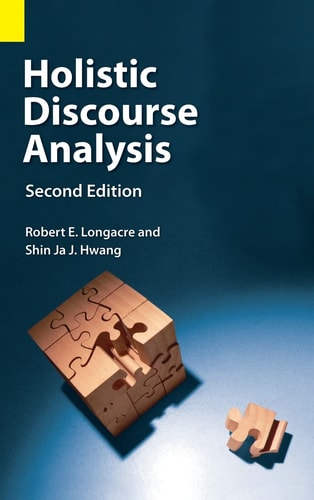
Holistic Discourse Analysis, Second Edition
0
0
As an Amazon Associate and affiliate partner, Menrva Books earns from qualifying purchases. Learn more
Author Description
The central idea of this volume is the insistence that the structure of a part of a text must be explained in light of the whole. This needs to be repeated anew to every generation of linguistics students as a warning against analytic nearsightedness-the fixation on parts of a text without regard to the whole. Holistic Discourse Analysis is not a plea to abandon the analysis of lower levels of grammar, but to enrich the study of them by putting them in broader perspective. The book addresses discourse analysis and its purpose, text typology, and constituent-based charting with an analysis of a story in terms of peak and profile. It discusses functions of different verb types and their tense/aspect/modality, of noun phrases, and of clause combining in discourse. It includes a chapter with a layman's introduction to discourse analysis, and another with ways to represent combinations of sentences in a paragraph. The last three chapters deal with nonnarrative discourses: procedural, hortatory, and expository. This Second Edition has significantly improved the usability of the volume by employing color-coding in illustrative texts so the reader can more easily visualize multiple levels of prominence in these texts. This book offers itself both as a classroom text and a field manual for discourse analysis. It can also serve as an introduction to the more theoretically oriented volume, Longacre's The Grammar of Discourse (1996). Robert Longacre has a Ph.D. from the University of Pennsylvania. He and his wife Gwen translated the New Testament into Trique, an Oto-Manguean language. From 1972 to 1991 he taught linguistics at the University of Texas at Arlington and served as a linguistic consultant for SIL. At present, he is researching the discourse structure of biblical Hebrew and also the theory and practice of discourse analysis in general. Shin Ja Hwang, was a student of Robert Longacre in her M.A. and Ph.D. studies and has worked with him as a colleague
Menrva's Summary
THE THESIS
The central idea of this volume is the insistence that the structure of a part of a text must be explained in light of the whole. This book argues for a holistic approach to discourse analysis, warning against the fixation on isolated parts of a text without regard to its overall structure. It aims to enrich the study of grammar by placing lower-level analyses within a broader perspective. The authors, experienced linguists with extensive fieldwork and academic backgrounds, present a comprehensive framework for understanding text structure.
THE SCOPE MAP
- Explanation of discourse analysis and its purpose.
- Discussion of text typology and constituent-based charting.
- Analysis of narrative discourse using peak and profile.
- Examination of verb types, tense, aspect, modality, noun phrases, and clause combining.
- A layman's introduction to discourse analysis.
- Methods for representing sentence combinations in paragraphs.
- Coverage of non-narrative discourses: procedural, hortatory, and expository.
THE AUTHORITY PERSPECTIVE
This second edition significantly improves usability by employing color-coding in illustrative texts, allowing readers to more easily visualize multiple levels of prominence. The book is designed to serve as both a classroom text and a field manual for discourse analysis, and can also function as an introduction to more theoretically oriented works. The authors' extensive experience in linguistics and translation lends authority to their approach.
Page Count:
264
Publication Date:
2012-09-10
Publisher:
Sil International, Global Publishing
ISBN-10:
1556715374
ISBN-13:
9781556715372
Literary Fiction
Non-Fiction
Grammar
Discourse Analysis
Linguistics
Community Tags
Similar Books

Reader Comments
Share Your Thoughts
No comments yet. Be the first to share your thoughts!