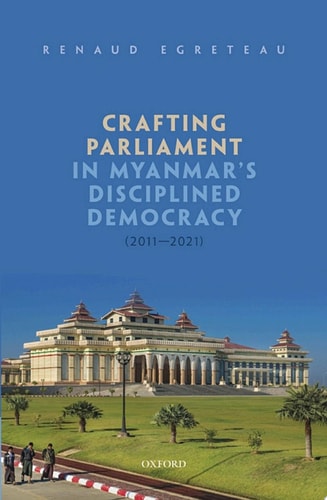
Crafting Parliament in Myanmar's Disciplined Democracy (2011-2021)
0
0
As an Amazon Associate and affiliate partner, Menrva Books earns from qualifying purchases. Learn more
Author Description
In January 2011, parliament was restored in Myanmar after two decades of military rule. Startlingly, it began to repeal obsolete laws, scrutinize government expenditures, summon ministers to the floor, and discuss the state's annual budget. It also allowed its elected representatives to make public the grievances collected from constituents infuriated at enduring practices of land confiscation, petty corruption, and everyday abuses of power. Yet ten years later in February 2021, parliament was shut down, again, by a coup d'état. What has been learned in the span of a decade of post-junta parliamentary resurgence? How could an elected legislature resurface - and function - in a country that had only limited experience with parliamentary affairs and representative politics since its independence from British rule? What lessons can be drawn from the Myanmar case for parliamentary institution-building and legislative developments (and decay) in post-authoritarian and praetorian contexts? This book offers a compelling account of Myanmar's halting efforts to develop the institutional framework and practice of a parliament-based democratic governance between 2011 and 2021. It charts the stages of such a legislative resurgence, tracing its causes, and exploring how various institutional and political legacies both informed and constrained the re-establishment and operations of the Union legislature, or Pyidaungsu Hluttaw. Embracing both ethnographic observations and a methodical engagement with legislative proceedings and historical material, Renaud Egreteau investigates how parliamentary life (re)emerged in Myanmar in the 2010s. His analysis concentrates on key legislative mechanisms, processes, and tasks pertaining to government oversight, budgetary control, representation, and lawmaking and interrogates how they were learned, (re)appropriated, and (mis)performed by Myanmar's new breed of legislators and parliamentary staff until the 2021 army takeover.
Menrva's Summary
THE THESIS
This book investigates the mechanisms, successes, and ultimate collapse of Myanmar's parliamentary system during the decade of democratic transition between 2011 and 2021. Renaud Egreteau, a specialist in Southeast Asian politics, utilizes a combination of ethnographic fieldwork, legislative records, and historical analysis to evaluate how a legislature functions within a post-authoritarian, praetorian environment. The author argues that while the Pyidaungsu Hluttaw made significant strides in government oversight and lawmaking, these efforts were fundamentally constrained by deep-seated military legacies and institutional fragility.
THE SCOPE MAP
What You Will Find
- Analysis of legislative processes including budgetary control and government oversight.
- Examination of the role of elected representatives in addressing constituent grievances.
- Ethnographic insights into the daily operations of the Pyidaungsu Hluttaw.
- Historical context regarding Myanmar's limited experience with representative politics.
Scope Limits
- The study concludes at the 2021 military coup and does not cover subsequent developments.
- The focus remains primarily on the institutional framework rather than broader societal movements.
THE AUTHORITY PERSPECTIVE
Experts recognize this work as a definitive account of Myanmar's legislative experiment during its brief democratic opening. Scholars frequently cite the book for its granular detail on the intersection of institutional building and military-dominated political structures.
Page Count:
535
Publication Date:
2022-01-01
Publisher:
OUP Oxford
ISBN-10:
0192674676
ISBN-13:
9780192674678
Legislative Studies
Comparative Politics
Government
Democracy
Burma Praññʻ thoṅʻ cu Lvhatʻ toʻ
Asian Studies
Community Tags
Similar Books