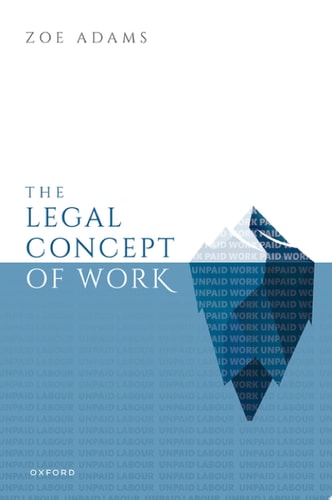
The Legal Concept of Work
0
0
As an Amazon Associate and affiliate partner, Menrva Books earns from qualifying purchases. Learn more
Author Description
"Why do we think about some practices as work, and not others? Why do we classify certain capacities as economically valuable skills, and others as innate characteristics? What, moreover, is the role of law in shaping our answers to these questions?" These are just some of the queries explored by Zoe Adams's analysis of the legal construction, and regulation, of work.Spanning from the 14th century to the present day, The Legal Concept of Work explores how the role of law and legal concepts comes to consider some forms of human labour as work, and some forms of human labour as non-work. It examines why perceptions of these activities can change over time, and how legal constitution impacts the way in which work comes to be regulated, organised, and valued.As part of the analysis, the book presents a series of case studies, ranging from the publishing industry, academia, medicine, and retail, with a view of illustrating some of the regulatory challenges different types of work face, in the context of capitalism.
Menrva's Summary
THE THESIS
This book investigates the legal mechanisms that define certain human activities as work while excluding others, questioning how law constructs economic value. Zoe Adams, a legal scholar, utilizes a historical and comparative framework to analyze the evolution of labor definitions from the 14th century to the modern era. The text argues that legal classifications are not neutral but are active instruments that shape the regulation, organization, and social valuation of labor within capitalist systems.
THE SCOPE MAP
What You Will Find
- Historical analysis of labor definitions from the 14th century to the present
- Case studies covering the publishing, academic, medical, and retail sectors
- Examination of the intersection between legal theory and economic value
Scope Limits
- Does not provide a comprehensive global history of labor law
- Focuses primarily on the conceptual construction of work rather than specific employment contract litigation
THE AUTHORITY PERSPECTIVE
Experts identify this work as a significant contribution to the critical study of labor law and its socio-economic implications. Readers frequently note the academic density of the prose, which is well-suited for researchers and students of legal history.
Page Count:
415
Publication Date:
2022-01-01
Publisher:
OUP Oxford
ISBN-10:
0192672339
ISBN-13:
9780192672339
Economics
History
Sociology
Professional Career & Trade
Labor Law
Law