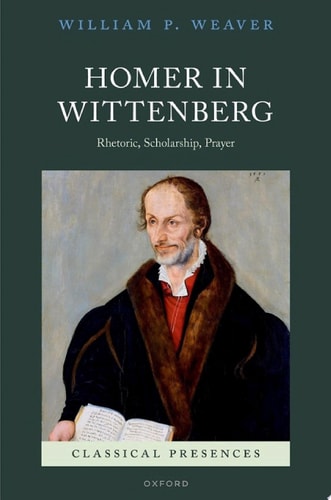
Homer in Wittenberg: Rhetoric, Scholarship, Prayer
0
0
As an Amazon Associate and affiliate partner, Menrva Books earns from qualifying purchases. Learn more
Author Description
Homer in Wittenberg draws on manuscript and printed materials to demonstrate Homer's foundational significance for educational and theological reform during the Reformation in Wittenberg. In the first study of Melanchthon's Homer annotations from three different periods spanning his career, and the first book-length study of his reading of a classical author, William Weaver offers a new perspective on the liberal arts and textual authority in the Renaissance and Reformation. Melanchthon's significance in the teaching of the liberal arts has long been recognized, but Homer's prominent place in his educational reforms is not widely known. Homer was instrumental in Melanchthon's attempt to transform the university curriculum, and his reforms of the liberal arts are clarified by his engagements with Homeric speech, a subject of interest in recent Homer scholarship. Beginning with his Greek grammar published just as he arrived in Wittenberg in 1518, and proceeding through his 1547 work on dialectic, Homer in Wittenberg shows that teaching Homer decisively shaped Melanchthon's redesign of grammar, logic, and rhetoric. Melanchthon embarked on reforming the liberal arts with the ultimate objective of reforming theological education. His teaching of Homer illustrates the philosophical principles behind his use of well-known theological terms including sola scriptura, law and gospel, and loci communes. Homer's significance extended even to a practical theology of prayer, and Wittenberg scholia on Homer from the 1550s illustrate how the Homeric poem could be used to exercise faith as well as literary judgment and eloquence.
Menrva's Summary
THE THESIS
How did the study of Homeric texts influence the educational and theological reforms initiated by Philipp Melanchthon in Wittenberg? William P. Weaver, a scholar specializing in Renaissance humanism and Reformation theology, utilizes a rigorous examination of manuscript annotations and printed materials to argue that Homer was a central, rather than peripheral, figure in the development of Melanchthon's pedagogical framework. By tracing the evolution of these annotations across three distinct periods of Melanchthon's career, Weaver demonstrates that the classical poet provided the structural foundation for the reformer's redesign of grammar, logic, and rhetoric.
THE SCOPE MAP
What You Will Find
- Analysis of Melanchthon's Homer annotations spanning his career from 1518 to the 1550s.
- Examination of the intersection between classical rhetoric and Reformation theological terms like 'sola scriptura' and 'loci communes'.
- Investigation into the role of Homeric speech in the transformation of the university curriculum.
Scope Limits
- The study focuses specifically on the Wittenberg context and Melanchthon's personal engagement with Homer.
- It does not provide a comprehensive history of Homeric reception across all of Europe during the sixteenth century.
THE AUTHORITY PERSPECTIVE
Experts recognize this work as a significant contribution to the study of Renaissance humanism and its integration into Reformation theology. Scholars frequently note the meticulous archival research and the clarity with which Weaver connects classical philology to the practical theological concerns of the Wittenberg reformers.
Page Count:
238
Publication Date:
2022-01-01
Publisher:
OUP Oxford
ISBN-10:
0192679139
ISBN-13:
9780192679130
History
Education - History
Literary Criticism
History of the Americas
Reformation
Theology
Community Tags
Similar Books