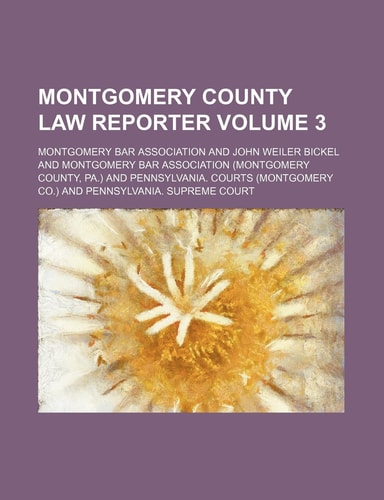
Montgomery County law reporter Volume 3
0
0
As an Amazon Associate and affiliate partner, Menrva Books earns from qualifying purchases. Learn more
Author Description
This historic book may have numerous typos and missing text. Purchasers can download a free scanned copy of the original book (without typos) from the publisher. Not indexed. Not illustrated. 1888 edition. Excerpt:... may cer-" tainly provide for a friend without exposing his bounty to the debts " or improvidence of the beneficiary. He has an individual right of " property in the execution of the trust, and to deprive him of it Ambler vs. Bayly. " would be a fraud on his generosity." In this case Julia Patterson received $2,600 cash in trust to invest in business, and use the profits for the maintenance of her father and his family. Nor can it make any difference that the trust relates to the distribution of the principal fund and not to its income. In Keyser vs. Mitchell, 67 P. S. R., 476, the trustee had the absolute discretion as to what part of the income or corpus should be paid to the cestui que trust, and the property as well as its income was protected against attaching creditors. If the testator can vest in the trustee such unlimited discretion as to the distribution of the corpus, why can not the testator himself apportion the fund, direct its distribution, and protect it in the hands of a trustee against the improvidence of his son by a clearly expressed intention to that effect? The father may-understand the wants, weaknesses and necessities of his son far better than any trustee he can appoint. We can see no good reason why the trust of a principal sum and a trust of income should not be governed by the same rules. The argument of the attaching creditors makes this but a dry or passive trust, and if they prevail against any installment now due they must also prevail against the entire fund. We think the testator stamped a trust upon the balance of his personal estate. Why is the executor to have the control of the fund if not to protect it from creditors? What other purpose can the trust subserve? If this purpose does not prevail, then the office...
Menrva's Summary
THE THESIS
This volume presents a collection of legal proceedings and decisions from Montgomery County, offering insights into the legal landscape of 1888. It focuses on case law, particularly concerning property rights, trusts, and the protection of beneficiaries from creditors.
THE SCOPE MAP
- Case summaries and legal arguments from Montgomery County.
- Analysis of trust law, including discretionary distribution of principal and income.
- Examination of legal precedents such as Ambler vs. Bayly and Keyser vs. Mitchell.
- Discussion on the testator's intent in establishing trusts to protect assets.
THE AUTHORITY PERSPECTIVE
This book serves as a primary source for understanding historical legal practices and judicial reasoning in a specific county during the late 19th century. The provided excerpt suggests a focus on contract law and the intricacies of estate and trust management, likely appealing to legal historians and scholars of jurisprudence. Its value lies in its direct presentation of case law, offering a window into the legal thought of the era.
Page Count:
80
Publication Date:
2012-07-11
Publisher:
RareBooksClub.com
ISBN-10:
1236664744
ISBN-13:
9781236664747
Non-Fiction
Legal History
Law