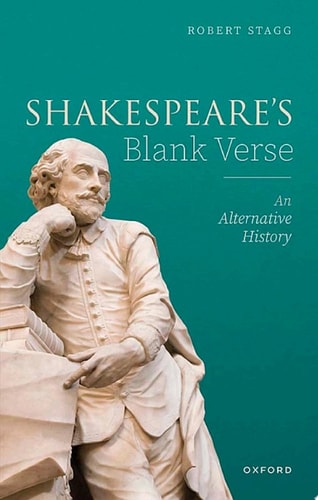
Shakespeare's Blank Verse: An Alternative History
0
0
As an Amazon Associate and affiliate partner, Menrva Books earns from qualifying purchases. Learn more
Author Description
Shakespeare's Blank Verse: An Alternative History is a study both of Shakespeare's versification and of its place in the history of early modern blank verse (unrhymed iambic pentameter). It ranges from the continental precursors of English blank verse in the early sixteenth century through the drama and poetry of Shakespeare's contemporaries to the editing of blank verse in the eighteenth century and beyond. Alternative in its argumentation as well as its arguments, Shakespeare's Blank Verse tries out fresh ways of thinking about meter—by shunning doctrinaire methods of apprehending a writer's versification, and by reconnecting meter to the fundamental literary, dramatic, historical, and social questions that animate Shakespeare's drama.
Menrva's Summary
THE THESIS
This study investigates how Shakespeare’s use of blank verse functions as a dynamic, evolving element of his drama rather than a static technical constraint. Robert Stagg, a scholar of early modern literature, challenges traditional metrical analysis by proposing a framework that integrates versification with the broader social, historical, and dramatic contexts of the period. By moving away from rigid, doctrinaire scanning methods, the author argues that meter serves as a vital tool for understanding the thematic and structural mechanics of Shakespearean performance.
THE SCOPE MAP
What You Will Find
- Analysis of continental precursors to English blank verse in the sixteenth century
- Examination of Shakespeare’s contemporaries and their influence on dramatic verse
- A historical overview of how blank verse was edited and perceived in the eighteenth century and beyond
- A methodology that links metrical variation to dramatic and social questions
Scope Limits
- Does not provide a comprehensive biography of Shakespeare
- Does not focus on non-dramatic poetry outside the context of blank verse development
THE AUTHORITY PERSPECTIVE
Scholars and students of early modern drama frequently note the book's departure from traditional scansion in favor of a more contextualized approach to meter. Experts highlight this work as a significant contribution to the study of Shakespearean prosody that bridges the gap between technical analysis and literary history.
Page Count:
351
Publication Date:
2022-01-01
Publisher:
OUP Oxford
ISBN-10:
0192677993
ISBN-13:
9780192677990
Poetry
Drama
Academic
English History
Poetry
English & College Success
English
Literary Criticism
Community Tags
Similar Books