Authority, Cooperation, and Accountability
0
0
As an Amazon Associate and affiliate partner, Menrva Books earns from qualifying purchases. Learn more
Author Description
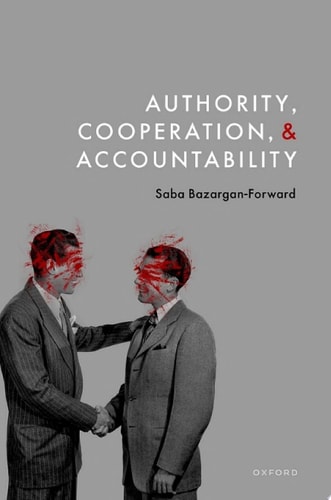
How should we decide a single employee's accountability in a corporation that commits egregious wrongs? What about a single solider fighting in an unjust war? Or a single participant in a lynching? We need a way to make sense of individual moral accountability in cases where multiple individuals are cooperating in a way that results in a wrongful harm. Authority, Cooperation, and Accountability develops a novel strategy for addressing this issue. Saba Bazargan-Forward makes the case for thinking that distinct aspects of human agency, normally wrapped up in a single person, can be 'distributed' practically across different people. He argues that we 'distribute' agency routinely, by forming promises, by making requests, by issuing demands, and by undertaking shared action. The resulting division of agential labour makes possible a distinctive way in which one person can be accountable for the actions of another. Bazargan-Forward highlights that what matters morally is not just our causal contributions to wrongful cooperative activity. In addition, the purposes we confer upon one another can inculpate us as well. The result is an account that can help us make sense of individual moral accountability in a bureaucratized world. The first half of the book develops a theory of accountability in the context of cooperation. The second half applies this theory to war ethics, criminal law, business ethics, and institutional racism.
Menrva's Summary
THE THESIS
This book investigates how individual moral accountability can be assigned when multiple agents cooperate to produce a wrongful outcome. Saba Bazargan-Forward, a scholar in moral and political philosophy, constructs a framework based on the distribution of human agency. He argues that through promises, requests, and shared actions, individuals divide agential labor, which allows for the attribution of moral responsibility for the actions of others within complex, bureaucratized systems.
THE SCOPE MAP
What You Will Find
- A theoretical framework for distributed agency and moral culpability.
- Analysis of how shared purposes and requests create moral obligations.
- Applications of the theory to war ethics, criminal law, business ethics, and institutional racism.
Scope Limits
- The text does not provide a comprehensive legal manual for specific jurisdictions.
- It does not focus on individual psychology or neuroscientific explanations of cooperation.
THE AUTHORITY PERSPECTIVE
Experts in moral philosophy recognize this work as a significant contribution to the study of collective responsibility and institutional ethics. Readers frequently note the rigorous analytical density of the prose, which is intended for an academic audience familiar with contemporary normative theory.
Page Count:
271
Publication Date:
2022-01-01
Publisher:
OUP Oxford
ISBN-10:
0192676571
ISBN-13:
9780192676573
Philosophy
War Ethics
Legal Theory
Business Ethics
Political Philosophy
Ethics
Community Tags
Similar Books