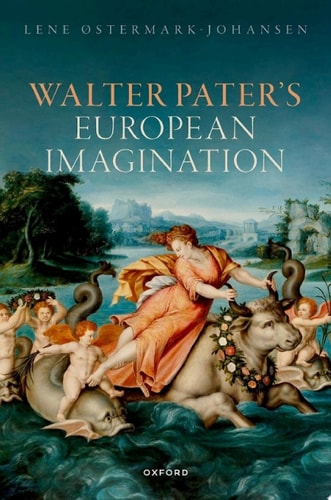
Walter Pater's European Imagination
0
0
As an Amazon Associate and affiliate partner, Menrva Books earns from qualifying purchases. Learn more
Author Description
Walter Pater's European Imagination addresses Pater's literary cosmopolitanism as the first in-depth study of his fiction in dialogue with European literature. Pater's short pieces of fiction, the so-called 'imaginary portraits', trace the development of the European self over a period of some two thousand years. They include elements of travelogue and art criticism, together with discourses on myth, history, and philosophy. Examining Pater's methods of composition, use of narrative voice, and construction of character, the book draws on all of Pater's oeuvre and includes discussions of a range of his unpublished manuscripts, essays, and reviews. It engages with Pater's dialogue with the visual portrait and problematises the oscillation between type and individual, the generic and the particular, which characterises both the visual and the literary portrait. Exploring Pater's involvement with nineteenth-century historiography and collective memory, the book positions Pater's fiction solidly within such nineteenth-century genres as the historical novel and the Bildungsroman, while also discussing the portraits as specimens of biographical writing. As the 'Ur-texts' from which generations of modernist life-writing developed, Pater's 'imaginary portraits' became pivotal for such modernist writers as Virginia Woolf and Harold Nicolson. Walter Pater's European Imagination explores such twentieth-century successors, together with French contemporaries like Sainte-Beuve and followers like Marcel Schwob.
Menrva's Summary
THE THESIS
This study investigates the literary cosmopolitanism of Walter Pater by analyzing his 'imaginary portraits' in the context of European intellectual and artistic traditions. Lene Østermark-Johansen, a scholar of Victorian literature, utilizes a comprehensive examination of Pater's published works, unpublished manuscripts, and critical reviews to argue that his fiction serves as a foundational bridge between nineteenth-century historiography and modernist life-writing. The author employs a comparative methodology to situate Pater's work within the broader development of the European self and the evolution of the portrait genre.
THE SCOPE MAP
What You Will Find
- Analysis of Pater's 'imaginary portraits' as a distinct literary genre.
- Comparative study of Pater alongside French contemporaries like Sainte-Beuve and successors such as Virginia Woolf.
- Examination of the intersection between nineteenth-century historiography, art criticism, and biographical writing.
Scope Limits
- The study focuses primarily on Pater's fiction and its relation to European literary traditions rather than a comprehensive biography of his life.
- It does not provide an exhaustive analysis of every minor review or ephemeral piece written by Pater.
THE AUTHORITY PERSPECTIVE
Scholars recognize this work as a significant contribution to the study of Pater's influence on modernist narrative techniques. Readers frequently note the academic density of the prose and the depth of the archival research presented throughout the text.
Page Count:
336
Publication Date:
2022-01-01
Publisher:
OUP Oxford
ISBN-10:
0192674692
ISBN-13:
9780192674692
Biography
Modernism
English & College Success
Nineteenth century
Literary Criticism
Art History
English
English literature
European
Community Tags
Similar Books