
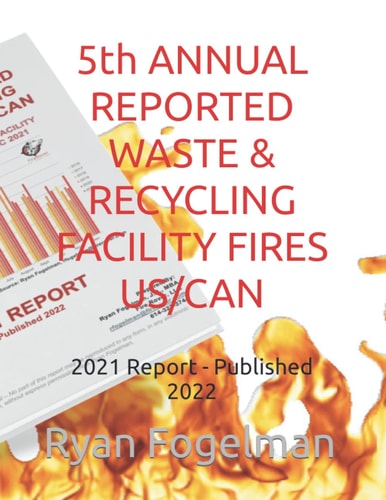
6th Annual Reported Waste & Recycling Facility Fires US & Canada: Best Practices for Dealing with Lithium-ion Battery Fires on the Frontlines
0
0
As an Amazon Associate and affiliate partner, Menrva Books earns from qualifying purchases. Learn more
Author Description
The world is finally catching up to the problem that we in the waste and recycling industry have known for years: Lithium-ion batteries are causing fires everywhere. In November 2022, the New York City Fire Department reported “191 fires, 140 injuries, and six deaths from lithium-ion fires in the city.” According to Councilwoman Joann Ariola, chair of the Committee on Fire and Emergency Management, “the city is on track to more than double the number of lithium-ion battery-related fires from last year and quadruple the number from 2020.” According to a survey released by Material Focus in the UK1 in December 2022, “The results suggest batteries that have not been removed from unwanted electrical products cause more than 700 fires annually in refuse collection vehicles and at household waste recycling centers, while nearly 90% of the 60 local authorities surveyed said fires caused by batteries are ‘an increasing problem.’” The equivalent number of fires would be 4,200 fire incidents in the U.S., almost double the number of fire incidents I have been reporting based on my assumptions since 2016. So, what took them so long? In 2017, based on my research, analysis, and unique position on the frontlines with Fire Rover, I was forecasting a wave of lithium-ion battery fires in waste streams due to several factors. In 2018, we saw that bump on a global scale. From 2019 until today, the leadership of the waste and recycling industry heard the call and took action to deal with these fires. These industrywide efforts included campaigns to educate the public on the dangers of lithium-ion batteries in the waste stream, operational best practices, and adopting innovative technologies like the Fire Rover. With all the excitement surrounding lithium-ion batteries as the main culprit of fires, we cannot overlook that fire hazards stem from several factors in the waste and recycling industry. Most data show that batteries are responsible for about half of the fires in th
Menrva's Summary
THE THESIS
The proliferation of lithium-ion batteries in waste streams has created a critical fire hazard, demanding immediate attention and best practices from the waste and recycling industry. The author, Ryan Fogelman, leverages his expertise and frontline experience to address the escalating problem of fires caused by these batteries in waste and recycling facilities across the US and Canada. This report details the increasing frequency of these incidents, citing alarming statistics from New York City and the UK, and explores the industry's response, including public education, operational adjustments, and technological solutions like Fire Rover, while also acknowledging other fire hazards present in the sector.
THE SCOPE MAP
- Analysis of reported waste and recycling facility fires in the US and Canada for the 6th annual period.
- Detailed examination of the role of lithium-ion batteries as a primary cause of these fires.
- Statistics and case studies from fire departments and industry surveys highlighting the scale of the problem.
- Discussion of the historical context and forecasting of lithium-ion battery fires in waste streams.
- Overview of industry-wide efforts and adopted solutions, including public awareness campaigns and technological interventions.
- Exploration of operational best practices for dealing with lithium-ion battery fires on the frontlines.
- Acknowledgement of other contributing factors to fire hazards within the waste and recycling industry.
THE AUTHORITY PERSPECTIVE
This report is presented as an annual assessment of a critical and growing issue within the waste and recycling sector. The author's background and direct involvement suggest a practical, data-driven approach to understanding and mitigating fire risks. The inclusion of statistics from various sources indicates an effort to provide a comprehensive overview of the problem's scope and impact. The focus on best practices and industry responses points to a resource aimed at professionals seeking to address these challenges.
Page Count:
148
Publication Date:
2023-03-13
Publisher:
Independently published
ISBN-13:
9798386873721
Science & Technology
Non-Fiction
Fire Safety
Recycling
Community Tags
Similar Books








Reader Comments
Share Your Thoughts
No comments yet. Be the first to share your thoughts!