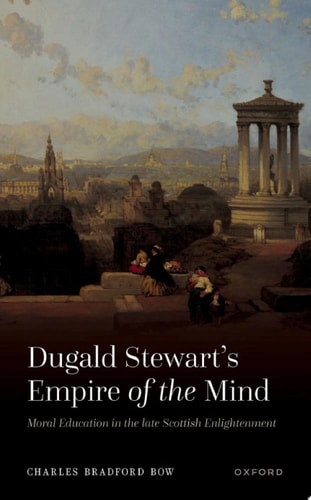
Dugald Stewart's Empire of the Mind: Moral Education in the Late Scottish Enlightenment
0
0
As an Amazon Associate and affiliate partner, Menrva Books earns from qualifying purchases. Learn more
Author Description
Dugald Stewart's Empire of the Mind recasts the cultivation of a democratic intellect in the late Scottish Enlightenment. It comprises an intellectual history of what was at stake in moral education during a transitional period of revolutionary change between 1772 and 1828. Stewart was a child of the Scottish Enlightenment, who inherited the Scottish philosophical tradition of teaching metaphysics as moral philosophy from the tuition of Adam Ferguson and Thomas Reid. But the Scottish Enlightenment intellectual culture of his youth changed in the aftermath of the French Revolution. Stewart sustained the Scottish school of philosophy by transforming how it was taught as professor of moral philosophy at the University of Edinburgh. His elementary system of moral education fostered an empire of the mind in the universal pursuit of happiness. The democratization of Stewart's didactic Enlightenment--the instruction of moral improvement--in a globalizing, interconnected nineteenth-century knowledge economy is examined in this book.
Menrva's Summary
THE THESIS
This book investigates how Dugald Stewart adapted the Scottish philosophical tradition to preserve moral education amidst the political and social upheavals following the French Revolution. Charles Bradford Bow, a scholar of intellectual history, utilizes archival research and pedagogical records from the University of Edinburgh to argue that Stewart transformed moral philosophy into a tool for democratic intellectual development. By examining Stewart's transition from the teachings of Adam Ferguson and Thomas Reid to his own didactic system, the author demonstrates how moral improvement became a central component of the nineteenth-century knowledge economy.
THE SCOPE MAP
What You Will Find
- Intellectual history of the Scottish Enlightenment between 1772 and 1828
- Analysis of the pedagogical shift in moral philosophy at the University of Edinburgh
- Examination of the democratization of knowledge in a globalizing economy
Scope Limits
- The text does not provide a comprehensive biography of Stewart's personal life outside of his academic and philosophical contributions
- It does not cover the influence of Stewart's philosophy on non-Western educational systems
THE AUTHORITY PERSPECTIVE
Scholars of the Scottish Enlightenment identify this work as a significant contribution to understanding the evolution of moral philosophy within academic institutions. Readers frequently note the academic density of the prose, which is tailored for those familiar with eighteenth-century intellectual history.
Page Count:
253
Publication Date:
2022-01-01
Publisher:
OUP Oxford
ISBN-10:
0192688979
ISBN-13:
9780192688972
History
Philosophy
Biography
Intellectual History
Mind & Body
Education
Scottish Enlightenment
Community Tags
Similar Books