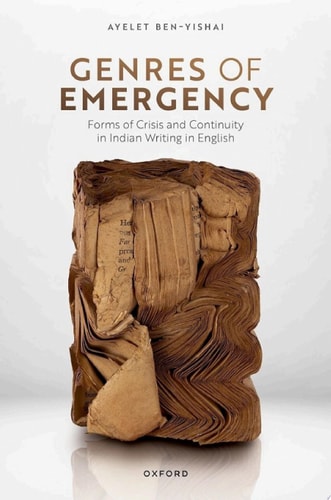
Genres of Emergency: Forms of Crisis and Continuity in Indian Writing in English
0
0
As an Amazon Associate and affiliate partner, Menrva Books earns from qualifying purchases. Learn more
Author Description
Genres of Emergency offers literary genre as a way to understand and negotiate the varied states of emergency and crisis that have become a fixture of our contemporary world. Building on a critical study of the literature written during and about the State of Emergency declared by Prime Minister Indira Gandhi in India (1975 - 1977), the study establishes emergency and its genres as an important interpretative site: an exceptionally violent episode marked as a one-off crisis, which also functions as a locus for an ongoing renegotiation of a modern polity and culture. Reading a wide-ranging archive of English-language texts - from prison memoir to popular magazine, from high-brow literary fiction to boilerplate thriller, from the unrelentingly realistic to the mythically allegorical - Genres of Emergency traces the tension between crisis and continuity that these genres mediate. In addressing this tension, the authors of Emergency fiction take seriously the genres in which they write and use them to mobilize literary conventions as political interventions. More specifically, these novels use the conventions of realism, epic, allegory, and the thriller to reach back in time and across cultures and languages, invoking past iterations of these genres and histories and anticipating those to come. Combining literary criticism with cultural history, Genres of Emergency thus has implications for the study of literary genre, for the historical events that these genres recount, and for understanding the politics of literary form.
Menrva's Summary
THE THESIS
How do literary genres function as mechanisms for negotiating and interpreting the state of emergency within the context of Indian political history? Ayelet Ben-Yishai, a scholar of postcolonial literature and culture, examines the 1975-1977 State of Emergency in India as a critical site for understanding how narrative forms mediate political crisis. By analyzing a diverse archive of English-language texts, the author argues that writers utilize specific generic conventions—such as realism, epic, and the thriller—to transform historical trauma into political intervention and cultural continuity.
THE SCOPE MAP
What You Will Find
- Analysis of literature produced during and about the 1975-1977 Indian State of Emergency.
- Examination of diverse formats including prison memoirs, popular magazines, and literary fiction.
- A theoretical framework connecting literary form to political history and state power.
Scope Limits
- The study focuses primarily on English-language texts rather than vernacular Indian literature.
- The analysis is restricted to the specific historical period of the Indira Gandhi Emergency and its immediate literary aftermath.
THE AUTHORITY PERSPECTIVE
Scholars in postcolonial studies and literary theory identify this work as a significant contribution to the study of how political crises shape narrative structures. Readers frequently note the academic density of the prose, which serves as a rigorous examination of the intersection between aesthetics and state governance.
Page Count:
210
Publication Date:
2023-01-01
Publisher:
OUP Oxford
ISBN-10:
0192691104
ISBN-13:
9780192691101
Literary Criticism
English literature
English & College Success
Political History
Indian
English
Community Tags
Similar Books