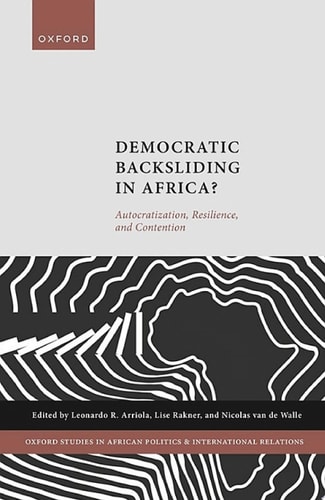
Democratic Backsliding in Africa?: Autocratization, Resilience, and Contention
0
0
As an Amazon Associate and affiliate partner, Menrva Books earns from qualifying purchases. Learn more
Author Description
This is an open access title available under the terms of a CC BY-NC 4.0 licence. It is free to read at Oxford Scholarship Online and offered as a free PDF download from OUP and selected open access locations. Why have most African countries not achieved greater political liberalization? What explains the lack of progress toward the ideals of liberal democracy across the region? This book advances ongoing debates on democratic backsliding with specific reference to Africa. In examining how incumbent leaders in African countries attempt to contain societal pressures for greater democracy, the chapters explain how governments go beyond the standard tools of manipulation, such as electoral fraud and political violence, to keep democracy from unfolding in their countries. The book emphasizes two distinct strategies that governments frequently use to reinforce their hold on power - the legal system and the international system - but which remain overlooked in conventional analyses; it also documents how governments employ the law to limit the scope of action among citizens and civil society activists struggling to expand democratic liberties, including the use of constitutional provisions and the courts. The work further demonstrates how governments use their role in international relations to neutralize pressure from external actors, including sovereigntist claims against foreign intervention and selective implementation of donor-promoted policies. While pro-democracy actors can also employ these legal and international strategies to challenge incumbents, in some cases to prevent democratic backsliding, the book shows why and how incumbents have enjoyed institutional advantages when implementing these strategies through six country case studies of Ghana, Kenya, Malawi, Uganda, Zambia, and Zimbabwe. Oxford Studies in African Politics and International Relations is a series for scholars and students working on African politics and International Relations and related disci
Menrva's Summary
THE THESIS
This book investigates why many African nations have failed to achieve sustained political liberalization and how incumbent leaders actively suppress democratic progress. The authors, Lise Rakner, Nicolas van de Walle, and Leonardo R. Arriola, utilize a comparative political framework to analyze the mechanisms of autocratization. They argue that beyond traditional methods like electoral fraud, regimes increasingly weaponize legal systems and international diplomatic channels to neutralize domestic and foreign pressures for reform.
THE SCOPE MAP
What You Will Find
- Comparative analysis of six African nations: Ghana, Kenya, Malawi, Uganda, Zambia, and Zimbabwe.
- Examination of legal strategies used to constrain civil society and activists.
- Analysis of how governments leverage international relations to deflect external democratic pressure.
- Case studies detailing the institutional advantages held by incumbents.
Scope Limits
- The study focuses primarily on the specific strategies of incumbent regimes rather than a comprehensive history of all African political movements.
- It does not provide an exhaustive survey of every nation on the continent, focusing instead on the selected six case studies.
THE AUTHORITY PERSPECTIVE
Scholars in the field of African politics identify this work as a significant contribution to the study of democratic resilience and institutional manipulation. Readers frequently note the academic rigor of the text, which serves as a foundational resource for understanding the complexities of contemporary autocratization in the region.
Page Count:
466
Publication Date:
2022-01-01
Publisher:
OUP Oxford
ISBN-10:
0192692887
ISBN-13:
9780192692887
Human rights
African
Democracy
Government
International relations
Community Tags
Similar Books