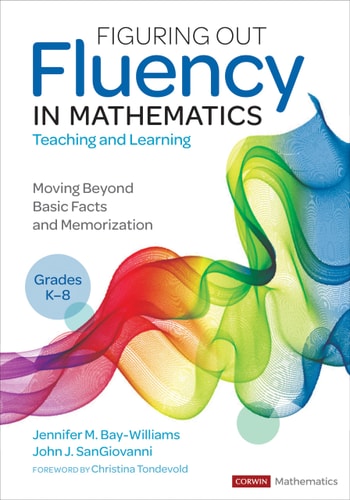
Figuring Out Fluency in Mathematics Teaching and Learning, Grades K-8: Moving Beyond Basic Facts and Memorization
0
0
As an Amazon Associate and affiliate partner, Menrva Books earns from qualifying purchases. Learn more
Author Description
Teach your students to become decision makers who rely on their own mathematical thinking. Fluency in mathematics is more than adeptly using basic facts or implementing algorithms. Real fluency involves reasoning and creativity, and it varies by the situation at hand. Figuring Out Fluency in Mathematics Teaching and Learning offers educators the inspiration to develop a deeper understanding of procedural fluency, along with a plethora of pragmatic tools for shifting classrooms toward a fluency approach. In a friendly and accessible style, this hands-on guide empowers educators to support students in acquiring the repertoire of reasoning strategies necessary to becoming versatile and nimble mathematical thinkers. It includes: "Seven Significant Strategies" to teach to students as they work toward procedural fluency. Activities, fluency routines, and games that encourage learning the efficiency, flexibility, and accuracy essential to real fluency. Reflection questions, connections to mathematical standards, and techniques for assessing all components of fluency. Suggestions for engaging families in understanding and supporting fluency. Fluency is more than a toolbox of strategies to choose from; it's also a matter of equity and access for all learners. Give your students the knowledge and power to become confident mathematical thinkers.
Menrva's Summary
THE THESIS
This book challenges the traditional view of mathematical fluency, advocating for a deeper understanding that moves beyond rote memorization and basic fact recall. It provides educators with practical strategies and tools to foster procedural fluency, emphasizing reasoning, creativity, and adaptability in K-8 students. The authors aim to equip teachers with methods to support students in developing a versatile repertoire of mathematical thinking skills, ultimately promoting equity and confidence in learners.
THE SCOPE MAP
- Strategies for developing procedural fluency beyond basic facts and algorithms.
- Activities, games, and routines designed to build efficiency, flexibility, and accuracy in mathematical thinking.
- Guidance on integrating reflection, connecting to standards, and assessing all components of fluency.
- Techniques for engaging families in supporting students' mathematical fluency development.
- Emphasis on equity and access for all learners in mathematics education.
THE AUTHORITY PERSPECTIVE
The book is presented as a practical guide for educators seeking to deepen their students' understanding of mathematical fluency. It offers a framework that prioritizes reasoning and creativity over rote memorization, providing actionable strategies and activities. The approach emphasizes developing versatile and nimble mathematical thinkers, with a stated goal of promoting equity and confidence in all learners. The content is structured to support teachers in shifting their classroom practices towards this more robust model of fluency.
Page Count:
264
Publication Date:
2021-01-01
Publisher:
Corwin Press
ISBN-10:
1071818422
ISBN-13:
9781071818428
Self-help
Non-Fiction
Mathematics
Education
Teaching Methods
Pedagogy
Community Tags
Similar Books