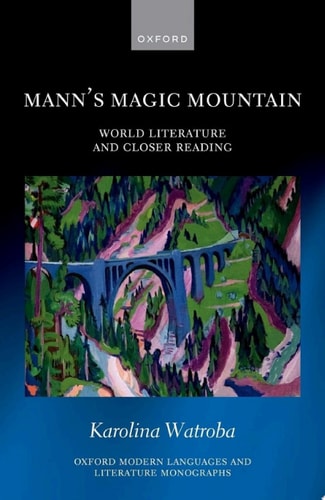
Mann's Magic Mountain: World Literature and Closer Reading
0
0
As an Amazon Associate and affiliate partner, Menrva Books earns from qualifying purchases. Learn more
Author Description
This is the first study of Thomas Mann's landmark German modernist novel Der Zauberberg (The Magic Mountain, 1924) that takes as its starting point the interest in Mann's book shown by non-academic readers. It is also a case study in a cluster of issues central to the interrelated fields of transnational German studies, global modernism studies, comparative literature, and reception theory: it addresses the global circulation of German modernism, popular afterlives of a canonical work, access to cultural participation, relationship between so-called 'high-brow' and 'low-brow' culture, and the limitations of traditional academic reading practices. The study intervenes in these discussions by developing a critical practice termed 'closer reading' and positioning it within the framework of world literature studies.Mann's Magic Mountain centres around nine comparative readings of five novels, three films, and one short story conceived as responses to The Magic Mountain. These works provide access to distinct readings of Mann's text on three levels: they function as records of their authors' reading of Mann, provide insights into broader culturally and historically specific interpretations of the novel, and feature portrayals of fictional readers of The Magic Mountain. These nine case studies are contextualized, complemented, enhanced, and expanded through references to hundreds of other diverse sources that testify to a lively engagement with The Magic Mountain outside of academic scholarship, including journalistic reviews, discussions on internet fora and blogs, personal essays and memoirs, Mann's fan mail and his replies to it, publishing advertisements, and marketing brochures from Davos, where the novel is set.
Menrva's Summary
THE THESIS
This study investigates how Thomas Mann's The Magic Mountain functions as a global cultural artifact by analyzing its reception among non-academic readers and its influence on subsequent creative works. Karolina Watroba, a scholar in modern languages, utilizes a methodology termed 'closer reading' to bridge the gap between canonical literary analysis and popular engagement. By examining the novel's circulation across different media and cultures, the author argues that the meaning of a text is continuously reconstructed through its diverse, non-academic readership.
THE SCOPE MAP
What You Will Find
- Comparative analysis of five novels, three films, and one short story inspired by The Magic Mountain
- A framework for 'closer reading' within the context of world literature studies
- Extensive documentation from non-academic sources including internet forums, fan mail, and marketing materials
Scope Limits
- The study does not provide a traditional line-by-line textual analysis of the original novel
- It focuses primarily on the reception and afterlife of the work rather than its initial composition history
THE AUTHORITY PERSPECTIVE
Scholars recognize this work as a significant contribution to reception theory and the study of global modernism. Readers frequently note the academic density of the prose while praising the author's innovative approach to bridging high-brow and low-brow cultural divides.
Page Count:
336
Publication Date:
2022-01-01
Publisher:
OUP Oxford
ISBN-10:
0192699857
ISBN-13:
9780192699855
Modernism
Reception Theory
English
English & College Success
Comparative
World Literature
Literary Criticism
German
Community Tags
Similar Books