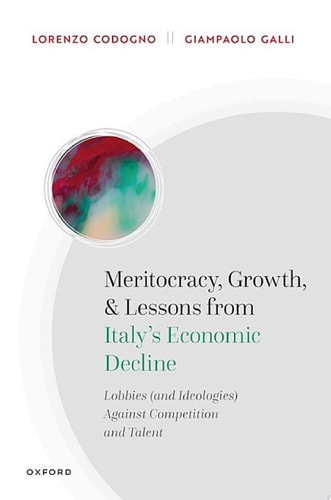
Meritocracy, Growth, and Lessons from Italy's Economic Decline: Lobbies (and Ideologies) Against Competition and Talent
0
0
As an Amazon Associate and affiliate partner, Menrva Books earns from qualifying purchases. Learn more
Author Description
This book draws lessons on the importance of meritocracy for economic growth by analysing Italy's economic decline in the past few decades. Connections, rather than merit, are a long-standing feature of the Italian elites, even in the corporate sector. This became a significant problem when Italy's economy could no longer grow due to imitation, devaluation, and public debt, and faced the challenges of becoming a frontier knowledge-based open economy. This book uses international comparisons on social capital, governance, the role of the public sector, efficiency of the judiciary, education, gender and social inequality, social mobility, corporate standards, financial structures, and more to evaluate Italy's economic performance. It argues that the arrogance of mediocracy is more damaging than that of meritocracy. Italy experienced an economic miracle after the Second World War, and it is still an advanced economy and a member of the G7. Until the 1960s it seemed destined to catch up with the best-performing countries. Then the growth engine stopped, its debt skyrocketed, and Italy became a weaker member of the Eurozone. Many other countries in the world have heavy historical legacies and low social capital, and many others have to make the jump from imitation led growth to endogenous growth. The lessons drawn from studying Italy's case can therefore have important international applications.
Menrva's Summary
THE THESIS
This book investigates the causal relationship between the erosion of meritocratic principles and Italy's prolonged economic stagnation. Authors Giampaolo Galli and Lorenzo Codogno, both seasoned economists with extensive experience in policy and financial analysis, argue that the dominance of entrenched lobbies and ideological resistance to competition has stifled Italy's transition into a modern, knowledge-based economy. By contrasting Italy's post-war growth miracle with its subsequent decline, the authors present a framework where social capital and institutional governance serve as the primary determinants of long-term prosperity.
THE SCOPE MAP
What You Will Find
- Comparative analysis of social capital, corporate governance, and judicial efficiency across G7 nations.
- Examination of structural barriers including social inequality, gender gaps, and educational shortcomings.
- Evaluation of the shift from imitation-led growth to endogenous, innovation-driven economic models.
Scope Limits
- The text does not provide a comprehensive history of Italian political parties, focusing instead on economic and structural institutional factors.
- It does not offer a detailed roadmap for immediate legislative reform, prioritizing diagnostic analysis over policy prescriptions.
THE AUTHORITY PERSPECTIVE
Experts identify this work as a rigorous diagnostic tool for understanding the structural rigidities within the Italian economy. Readers frequently note the academic density of the prose, which provides a comprehensive look at how institutional failures impact national competitiveness.
Page Count:
414
Publication Date:
2022-01-01
Publisher:
OUP Oxford
ISBN-10:
0192692216
ISBN-13:
9780192692214
Economics
Sociology
Economic History
Italy
Public Policy
Community Tags
Similar Books