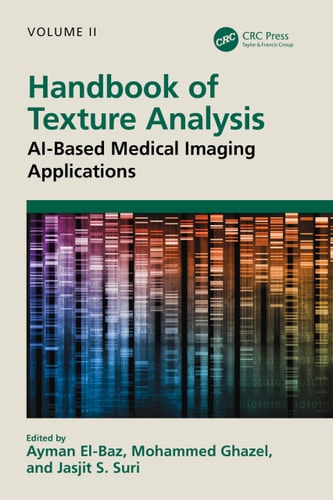
Handbook of Texture Analysis: AI-Based Medical Imaging Applications
0
0
As an Amazon Associate and affiliate partner, Menrva Books earns from qualifying purchases. Learn more
Author Description
The major goals of texture research in computer vision are to understand, model, and process texture and, ultimately, to simulate the human visual learning process using computer technologies. In the last decade, artificial intelligence has been revolutionized by machine learning and big data approaches, outperforming human prediction on a wide range of problems. In particular, deep learning convolutional neural networks (CNNs) are particularly well suited to texture analysis. This volume presents important branches of texture analysis methods which find a proper application in AI-based medical image analysis. This book: Discusses first-order, second-order statistical methods, local binary pattern (LBP) methods, and filter bank-based methods Covers spatial frequency-based methods, Fourier analysis, Markov random fields, Gabor filters, and Hough transformation Describes advanced textural methods based on DL as well as BD and advanced applications of texture to medial image segmentation Is aimed at researchers, academics, and advanced students in biomedical engineering, image analysis, cognitive science, and computer science and engineering This is an essential reference for those looking to advance their understanding in this applied and emergent field.
Menrva's Summary
THE THESIS
This handbook investigates the application of artificial intelligence, particularly deep learning, to texture analysis in medical imaging. The volume details how machine learning and big data approaches have revolutionized AI, with convolutional neural networks (CNNs) proving highly effective for texture analysis. It presents key branches of texture analysis methods relevant to AI-based medical image analysis, covering statistical, local binary pattern, filter bank, spatial frequency, Fourier analysis, Markov random fields, Gabor filters, and Hough transformation techniques. Additionally, it explores advanced DL and BD-based textural methods and their applications in medical image segmentation.
THE SCOPE MAP
- First-order, second-order statistical methods, and local binary pattern (LBP) methods
- Filter bank-based methods, spatial frequency-based methods, and Fourier analysis
- Markov random fields, Gabor filters, and Hough transformation
- Advanced textural methods based on Deep Learning (DL) and Big Data (BD)
- Applications of texture analysis to medical image segmentation
THE AUTHORITY PERSPECTIVE
The book is positioned as an essential reference for researchers, academics, and advanced students in biomedical engineering, image analysis, cognitive science, and computer science and engineering. Its focus on AI-based medical imaging applications suggests it aims to provide a comprehensive overview of current and advanced techniques in the field. The detailed coverage of various texture analysis methods, from statistical approaches to deep learning, indicates a thorough exploration of the subject matter. The framing suggests a text that bridges theoretical concepts with practical applications in a rapidly evolving domain.
Page Count:
248
Publication Date:
2025-12-26
Publisher:
CRC Press
ISBN-10:
1032727438
ISBN-13:
9781032727431
Science & Technology
Non-Fiction
Data Science
Biomedical Engineering
Computer Science
Machine Learning
Community Tags
Similar Books