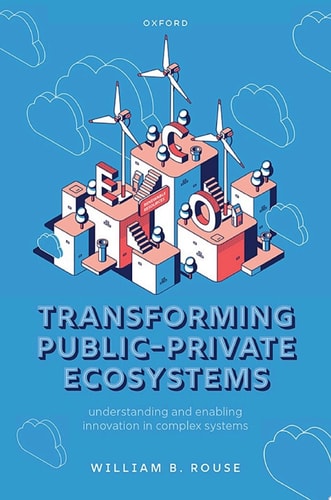
Transforming Public-Private Ecosystems: Understanding and Enabling Innovation in Complex Systems
0
0
As an Amazon Associate and affiliate partner, Menrva Books earns from qualifying purchases. Learn more
Author Description
Public-private collaborations are central to the functioning and provisioning of most essential ecosystems. Ecosystems such as security, healthcare, education, and the environment face challenges of governance, diverse constituencies, numerous advocacy organizations, incompatible outcome metrics, and persistent media attention, to name a few. There is a wide range of public and private players involved in operating, sustaining, and investing in these ecosystems, including stakeholders from government, industry, academia, non-governmental organizations, and the general public. Fundamental change requires understanding a wide range of interests and accommodating change strategies accordingly. The challenges of transforming these ecosystems would easily qualify as “wicked problems”; social or cultural problems laced with incomplete or contradictory knowledge, large numbers of people and opinions, substantial economic burdens, and inextricable connections with other issues. Transforming Public-Private Ecosystems addresses these challenges for the four important ecosystems of national security, healthcare delivery, higher education, and energy and climate, and provides an integrated perspective for understanding and enabling change.
Menrva's Summary
THE THESIS
How can stakeholders effectively navigate and transform complex public-private ecosystems that are characterized by conflicting interests and wicked problems? Dr. William B. Rouse, an expert in systems engineering and management, utilizes his extensive background in complex systems to provide a structured framework for organizational change. He argues that because these ecosystems involve diverse constituencies and contradictory knowledge, traditional management approaches are insufficient. The book proposes an integrated perspective that accounts for the economic, social, and cultural variables inherent in large-scale public-private collaborations.
THE SCOPE MAP
What You Will Find
- Analysis of four primary ecosystems: national security, healthcare delivery, higher education, and energy and climate.
- Frameworks for identifying and managing stakeholders with competing outcome metrics.
- Methodologies for addressing wicked problems within multi-organizational environments.
Scope Limits
- The text does not provide specific policy recommendations for individual local government jurisdictions.
- It does not focus on the technical engineering aspects of energy or medical infrastructure, but rather on the management and governance of those systems.
THE AUTHORITY PERSPECTIVE
Experts in systems engineering and public administration identify this work as a rigorous examination of the structural challenges facing modern institutional collaboration. Readers frequently note the academic density of the prose, which is best suited for professionals and researchers involved in high-level policy and organizational management.
Page Count:
437
Publication Date:
2022-01-01
Publisher:
OUP Oxford
ISBN-10:
0192691724
ISBN-13:
9780192691729
Business
Public Policy
Business Ethics
Systems Thinking
Governance
Innovation
Management
Community Tags
Similar Books