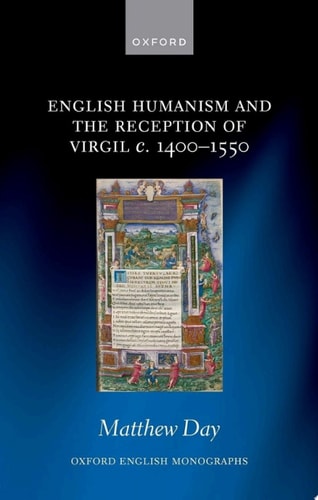
English Humanism and the Reception of Virgil c. 1400-1550
0
0
As an Amazon Associate and affiliate partner, Menrva Books earns from qualifying purchases. Learn more
Author Description
English Humanism and the Reception of Virgil c. 1400-1550 reassesses how the spread of Renaissance humanism in England impacted the reception of Virgil. It begins with the first signs of humanist influence in the fifteenth century, and ends at the height of the English Renaissance during the mid-Tudor period. This period witnessed the first extant English translations of Virgil's Aeneid, by William Caxton (1490), Gavin Douglas (1513), and the Earl of Surrey (c. 1543). It also marked the first printings of Virgil's works in England by Richard Pynson (c. 1515) and Wynkyn de Worde (1510s-1520s). Through a fine-grained analysis of surviving manuscripts and early printed editions, Matthew Day questions how and to what extent Renaissance humanism impacted readers' and translators' approaches to Virgil. Building on current scholarship in the fields of book history, classical reception, and translation studies, it draws attention to substantial continuities between the medieval and humanist reception of Virgil's works. Humanist study of Virgil, and indeed of classical poetry more generally, continued to draw many of its aims, methods, and conventions from well-established medieval traditions of learning. In emphasizing the very gradual pace of humanist development and the continuous influence of medieval scholarship, the book comes to a more qualified view of how humanism did and (just as importantly) did not affect Virgilian reading and translation. While recognizing humanist innovations and discoveries, it gives due attention to the understudied, yet far more numerous examples of consistency and traditionalism.
Menrva's Summary
THE THESIS
This work investigates the extent to which the emergence of Renaissance humanism in England fundamentally altered the reception and translation of Virgil's works between 1400 and 1550. Matthew Day, an academic scholar, utilizes a rigorous analysis of surviving manuscripts and early printed editions to challenge the narrative of a sharp break between medieval and humanist scholarship. He argues that humanist engagement with classical poetry remained deeply indebted to established medieval traditions of learning, suggesting a more gradual and continuous evolution of thought than previously assumed.
THE SCOPE MAP
What You Will Find
- Analysis of early English printings of Virgil by Richard Pynson and Wynkyn de Worde.
- Examination of foundational translations by William Caxton, Gavin Douglas, and the Earl of Surrey.
- A comparative framework between medieval pedagogical methods and humanist innovations.
Scope Limits
- The study is strictly confined to the English context between 1400 and 1550.
- It does not provide a comprehensive biography of Virgil or a general history of the Renaissance.
THE AUTHORITY PERSPECTIVE
Scholars in the fields of classical reception and book history identify this text as a significant contribution to understanding the transition from medieval to early modern intellectual culture. Readers frequently note the academic density of the prose, which serves as a specialized resource for researchers examining the history of translation and humanist pedagogy.
Page Count:
235
Publication Date:
2022-01-01
Publisher:
OUP Oxford
ISBN-10:
0192698885
ISBN-13:
9780192698889
Education - History
Book History
English & College Success
Translation Studies
English
Classical Reception
Literary Criticism