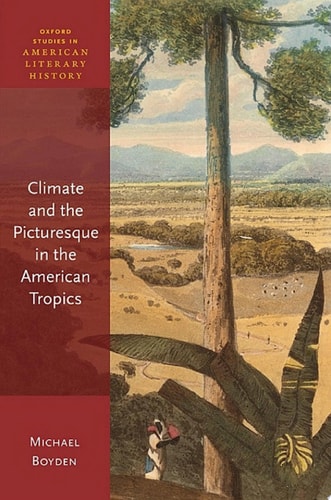
Climate and the Picturesque in the American Tropics
0
0
As an Amazon Associate and affiliate partner, Menrva Books earns from qualifying purchases. Learn more
Author Description
The biggest challenge of the twenty-first century is to bring the effects of public life into relation with the intractable problem of global atmospheric change. Climate and the Picturesque in the American Tropics explains how we came to think of the climate as something abstract and remote rather than a force that actively shapes our existence. The book argues that this separation between climate and sensibility predates the rise of modern climatology and has deep roots in the era of colonial expansion, when the American tropics were transformed into the economic supplier for Euro-American empires. The book shows how the writings of American travellers in the Caribbean registered and pushed forward this new understanding of the climate in a pivotal period in modern history, roughly between 1770 and 1860, which was fraught with debates over slavery, environmental destruction, and colonialism. Offering novel readings of authors including J. Hector St. John de Crevecœur, Leonora Sansay, William Cullen Bryant, Nathaniel Hawthorne, Sophia Peabody, Ralph Waldo Emerson, and James McCune Smith in light of their engagements with the American tropics, this book shows that these authors drew on a climatic epistemology that fused science and sentiment in ways that citizen science is aspiring to do today. By suggesting a new genealogy of modern climate thinking, Climate and the Picturesque in the American Tropics thus highlights the urgency of revisiting received ideas of tropicality deeply ingrained in American culture that continue to inform current debates on climate debt and justice.
Menrva's Summary
THE THESIS
This book investigates how the conceptual separation between human sensibility and climate originated during the era of colonial expansion in the American tropics. Michael Boyden, a scholar of American literary history, utilizes a framework that bridges environmental science and literary analysis to examine how 18th and 19th-century writers perceived tropical environments. He argues that the abstraction of climate as a remote phenomenon is a historical construct rooted in the economic exploitation of the Caribbean, which continues to influence contemporary discourse on climate justice.
THE SCOPE MAP
What You Will Find
- An analysis of climate epistemology between 1770 and 1860.
- Literary readings of authors including Crevecœur, Sansay, Bryant, Hawthorne, and Emerson.
- A historical examination of the intersection between colonial expansion, slavery, and environmental perception.
Scope Limits
- The study focuses primarily on the American tropics and Euro-American literary perspectives rather than global climate history.
- It does not provide a technical scientific manual on modern climatology.
THE AUTHORITY PERSPECTIVE
Scholars in the field of American literary history recognize this work as a significant contribution to the study of environmental humanities and colonial discourse. Readers frequently note the academic density of the prose and the depth of the historical research provided by the author.
Page Count:
365
Publication Date:
2022-01-01
Publisher:
OUP Oxford
ISBN-10:
0192694448
ISBN-13:
9780192694447
Literary Criticism
Trades & Technology
Cultural History
Environmental History
Environmental
Colonialism
American Studies