The Economics and Politics of High-Speed Rail
0
0
As an Amazon Associate and affiliate partner, Menrva Books earns from qualifying purchases. Learn more
Author Description
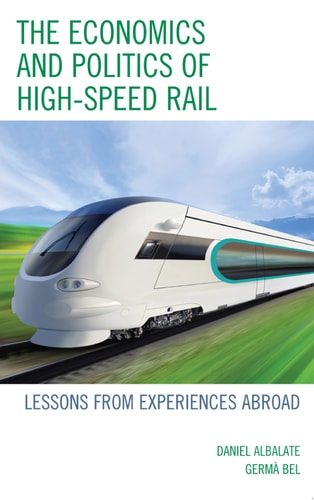
The technological revolution linked to high speed rail (HSR) has been accompanied by myths and claims about its contribution to society and the economy. Although HSR is unquestionably a technological advance that has become a symbol of modernity, this review and analysis of the international experiences shows that the conditions necessary to have a positive impact, economically, socially and environmentally, are enormously restrictive. The Economics and Politics of High Speed Rail: Lessons from Experiences Abroad, by Daniel Albalate and Germà Bel, introduces the main questions policy makers and scholars should examine when considering and studying HSR implementation, with particular emphasis on the US’s recent interest in this technology and possible application in California. Albalate and Bel then review the experiences of the most significant implementations of HSR around the globe. This in-depth international perspective includes chapters on the pioneers of HSR (Japan and France), the European followers (Germany, Spain and Italy), as well as Asian experiences in China, Taiwan, and Korea. Albalate and Bel’s study provides a clear distinction between the myths and realities associated with this transportation innovation. Among the most relevant findings, this study highlights how HSR projects that do not satisfy highly restrictive conditions—on mobility patterns, measured costs, and economically rational designs—that make it desirable have been the source of huge financial debacles and the economic failure of HSR in most cases, which result in unfortunate consequences for taxpayers. The Economics and Politics of High Speed Rail is a rigorous investigation of the economic and political challenges and ramifications of implementing new public transportation technology.
Menrva's Summary
THE THESIS
This book investigates the economic and political realities behind the widespread adoption of high-speed rail (HSR), challenging prevailing myths about its societal benefits. The authors, Daniel Albalate and Germà Bel, analyze international experiences to reveal the highly restrictive conditions required for HSR to yield positive economic, social, and environmental impacts. They scrutinize the implementation of HSR, particularly in light of recent US interest, and present a clear distinction between the perceived advantages and the actual financial and economic outcomes, often resulting in significant costs for taxpayers.
THE SCOPE MAP
- Analysis of the economic and political challenges of implementing high-speed rail.
- Review of international experiences with HSR, including pioneers (Japan, France) and followers (Germany, Spain, Italy, China, Taiwan, Korea).
- Examination of the restrictive conditions necessary for HSR to achieve positive economic, social, and environmental impacts.
- Distinction between myths and realities surrounding HSR as a transportation innovation.
- Focus on the US's recent interest in HSR, with specific attention to California.
- Identification of financial debacles and economic failures of HSR projects that do not meet stringent criteria.
THE AUTHORITY PERSPECTIVE
The book provides a rigorous investigation into the economic and political ramifications of implementing new public transportation technology like high-speed rail. It highlights how projects failing to meet specific, restrictive conditions regarding mobility patterns, costs, and design have frequently led to substantial financial losses for taxpayers. The analysis aims to separate the technological advancement of HSR from its often-overstated economic and social contributions.
Page Count:
211
Publication Date:
2012-06-14
Publisher:
Bloomsbury USA
ISBN-13:
9798881885953
History
Non-Fiction
Economics
Transportation
Infrastructure
Public Policy
Community Tags
Similar Books