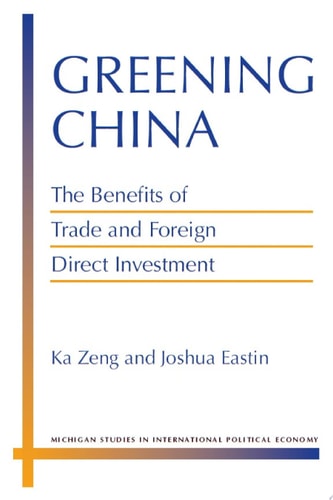
Greening China: The Benefits of Trade and Foreign Direct Investment
0
0
As an Amazon Associate and affiliate partner, Menrva Books earns from qualifying purchases. Learn more
Author Description
China has earned a reputation for lax environmental standards that allegedly attract corporations more interested in profit than in moral responsibility and, consequently, further negate incentives to raise environmental standards. Surprisingly, Ka Zeng and Joshua Eastin find that international economic integration with nation-states that have stringent environmental regulations facilitates the diffusion of corporate environmental norms and standards to Chinese provinces. At the same time, concerns about "green" tariffs imposed by importing countries encourage Chinese export-oriented firms to ratchet up their own environmental standards. The authors present systematic quantitative and qualitative analyses and data that not only demonstrate the ways in which external market pressure influences domestic environmental policy but also lend credence to arguments for the ameliorative effect of trade and foreign direct investment on the global environment.
Menrva's Summary
THE THESIS
This book investigates the surprising positive impact of international economic integration on China's environmental standards. Despite China's reputation for lax environmental regulations, Ka Zeng and Joshua Eastin demonstrate how trade and foreign direct investment, particularly with countries possessing stringent environmental laws, facilitate the adoption of higher corporate environmental norms within Chinese provinces. Furthermore, the threat of 'green' tariffs from importing nations incentivizes Chinese export-oriented firms to improve their environmental performance. The authors utilize systematic quantitative and qualitative analyses to support their argument that external market pressures can effectively influence domestic environmental policy and contribute to a healthier global environment.
THE SCOPE MAP
- Analysis of how stringent environmental regulations in importing countries influence Chinese provinces.
- Examination of the role of 'green' tariffs in motivating Chinese export-oriented firms.
- Presentation of systematic quantitative data supporting the thesis.
- Inclusion of qualitative analyses to demonstrate mechanisms of influence.
- Discussion of the ameliorative effect of trade on the global environment.
- Exploration of the diffusion of corporate environmental norms and standards.
THE AUTHORITY PERSPECTIVE
The book presents a counter-intuitive argument regarding China's environmental progress through international economic engagement. The authors' systematic quantitative and qualitative analyses aim to demonstrate how external market pressures, including stringent regulations in trading partners and the threat of green tariffs, positively influence domestic environmental policy and corporate standards. This work contributes to the ongoing debate about the environmental consequences of globalization, specifically in the context of China's rapid economic development.
Page Count:
249
Publication Date:
2011-01-01
Publisher:
University of Michigan Press
ISBN-10:
0472901192
ISBN-13:
9780472901197
Politics
Non-Fiction
Economics
International Trade
Foreign direct investment
China Studies
Community Tags
Similar Books