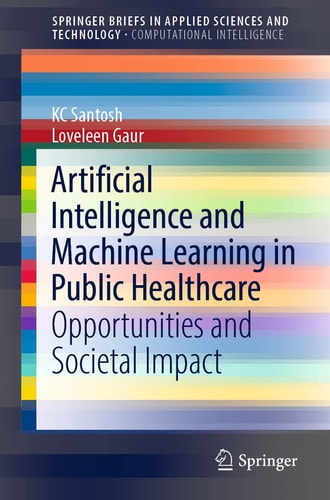
Artificial Intelligence and Machine Learning in Public Healthcare: Opportunities and Societal Impact
0
0
As an Amazon Associate and affiliate partner, Menrva Books earns from qualifying purchases. Learn more
Author Description
This book discusses and evaluates AI and machine learning (ML) algorithms in dealing with challenges that are primarily related to public health. It also helps find ways in which we can measure possible consequences and societal impacts by taking the following factors into account: open public health issues and common AI solutions (with multiple case studies, such as TB and SARS: COVID-19), AI in sustainable health care, AI in precision medicine and data privacy issues. Public health requires special attention as it drives economy and education system. COVID-19 is an example—a truly infectious disease outbreak. The vision of WHO is to create public health services that can deal with abovementioned crucial challenges by focusing on the following elements: health protection, disease prevention and health promotion. For these issues, in the big data analytics era, AI and ML tools/techniques have potential to improve public health (e.g., existing healthcare solutions and wellness services). In other words, they have proved to be valuable tools not only to analyze/diagnose pathology but also to accelerate decision-making procedure especially when we consider resource-constrained regions.
Menrva's Summary
THE THESIS
This book investigates the application and implications of Artificial Intelligence (AI) and Machine Learning (ML) within public healthcare systems. It examines how these technologies can address critical public health challenges, with a focus on measuring potential consequences and societal impacts, drawing on case studies like TB and SARS: COVID-19. The text explores AI's role in sustainable healthcare, precision medicine, and data privacy, emphasizing its potential to enhance health protection, disease prevention, and health promotion, particularly in resource-constrained regions.
THE SCOPE MAP
- Evaluation of AI and ML algorithms for public health challenges.
- Analysis of AI solutions for specific diseases (e.g., TB, SARS: COVID-19) with case studies.
- Discussion of AI's role in sustainable healthcare practices.
- Exploration of AI in precision medicine.
- Examination of data privacy issues related to AI in healthcare.
- Consideration of AI's impact on economic and educational systems through public health.
- Alignment with WHO's vision for public health services (health protection, disease prevention, health promotion).
THE AUTHORITY PERSPECTIVE
The book is positioned as a comprehensive evaluation of AI and ML in public healthcare, highlighting their potential to address significant challenges and improve decision-making, especially in data-scarce environments. It aims to provide insights into sustainable healthcare, precision medicine, and data privacy concerns. The inclusion of case studies, such as those related to COVID-19, suggests a practical and evidence-based approach to understanding the societal impacts of these technologies in public health.
Page Count:
74
Publication Date:
2021-11-27
Publisher:
Springer Nature Singapore
ISBN-10:
9811667675
ISBN-13:
9789811667671
Science & Technology
Non-Fiction
Data privacy
Healthcare Technology
Machine Learning
Case studies
Public Health
Community Tags
Similar Books