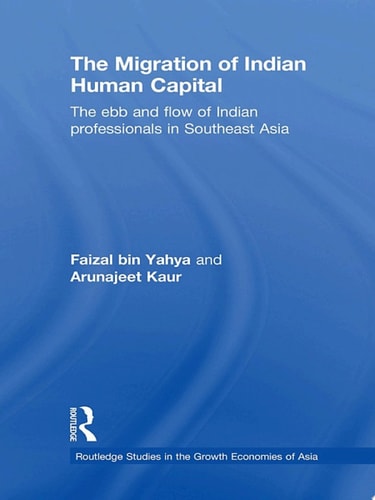
The Migration of Indian Human Capital
0
0
As an Amazon Associate and affiliate partner, Menrva Books earns from qualifying purchases. Learn more
Author Description
In an increasingly globalised world manifested in greater economic integration, human capital is an important factor. One of the key sources of human capital to the global economy is India, and the main destinations for Indian professionals has been Western developed economies, the Middle East and Gulf regions and East and Southeast Asia. Southeast Asia as a region has close historical, social and cultural linkages with India, and India has undertaken a number of initiatives under its "Look East" policy (LEP) to enhance ties with the Southeast Asian region. This book examines the trends and motivations of human capital flows from India into this region. Focusing in particular on Malaysia, Singapore, Indonesia and Thailand, the book provides an analysis of Indian labour in a variety of sectors, including information technology (IT) sector, academia, banking, oil and gas. Based on empirical data, the book provides an analysis of current trends in the flow of human capital from India to Southeast Asia. It will be of interest to policy makers, businessmen, students, analysts and academics in the field of Asian studies, foreign relations, human capital and labour migration.
Menrva's Summary
THE THESIS
This book investigates the patterns and drivers of human capital migration from India to Southeast Asia.
In an increasingly globalized world, human capital is a critical economic factor, with India being a significant source. This book examines the flow of Indian professionals to Western developed economies, the Middle East, and Southeast Asia, a region with close historical and cultural ties to India. The study focuses on Malaysia, Singapore, Indonesia, and Thailand, analyzing the presence of Indian labor across various sectors including IT, academia, banking, and oil and gas. Drawing on empirical data, it provides an analysis of current trends in this specific migration corridor.
THE SCOPE MAP
- Analysis of human capital flows from India to Southeast Asia.
- Focus on key Southeast Asian countries: Malaysia, Singapore, Indonesia, and Thailand.
- Examination of Indian labor in sectors such as Information Technology (IT), academia, banking, and oil and gas.
- Based on empirical data to analyze current trends.
- Exploration of the motivations behind Indian professionals migrating to the region.
- Consideration of India's "Look East" policy and its impact on ties with Southeast Asia.
THE AUTHORITY PERSPECTIVE
The book offers a data-driven analysis of a significant contemporary trend in global labor migration. Its focus on the specific corridor between India and Southeast Asia, examining key sectors and countries, provides valuable insights for policymakers, businessmen, and academics. The empirical approach suggests a detailed and evidence-based examination of the subject matter. The work is positioned to be of interest to those engaged in Asian studies, foreign relations, and human capital research.
Page Count:
256
Publication Date:
2010-12-03
Publisher:
Taylor & Francis
ISBN-10:
1134018169
ISBN-13:
9781134018161
Economics
Non-Fiction
Politics
Southeast Asia
Indonesia
Banking
Thailand
Human Capital
Singapore
Information Technology
Malaysia
Oil and Gas
Asian Studies
Community Tags
Similar Books