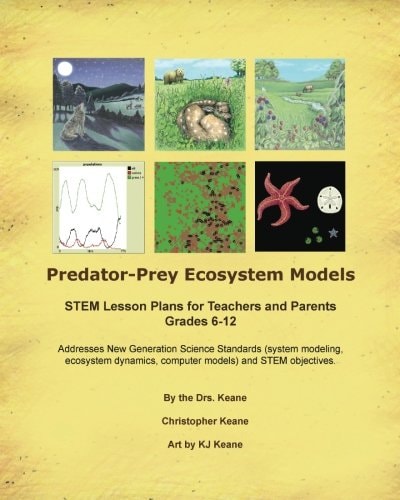
Predator-Prey Ecosystem Models: STEM Lesson Plans for Teachers and Parents, Grades 6-12
0
0
As an Amazon Associate and affiliate partner, Menrva Books earns from qualifying purchases. Learn more
Author Description
These lessons should give you and your student a bird’s-eye view of predator-prey ecosystem models. The topic of our systems modeling in these lessons is predator-prey dynamics, but students also will learn about systems modeling generally. The New Generation Science Standards (NGSS) emphasize system modeling as a crucial skill, and include ecosystem dynamics as an important example. Systems modeling incorporates science and math, but does not focus on isolated scientific facts or rote learning of math. Our systems modeling approach emphasizes how parts interact to create a working whole, and shows how a whole complex system is more than the mere sum of its parts. Easy to learn computer coding directs how the system model parts interact. We use system modeling graphics and creative art to visualize the interaction of parts within the whole. Thus, our approach naturally integrates science, math, and art as well as system modeling to meet STEM, STEAM, Common Core, and NGSS objectives. The lessons have accompanying computer models, which you can use through a web browser. Although these models are easy to use, the learning can go ever deeper. All ages will get a big picture perspective of fascinating social and ecological dynamics affecting the health of our world. Included is an outdoor wondering exercise, which stimulates or reinforces critical thinking, a “wondering why” and a sense of awe. We aim to help you and your student soar to new perspectives and better appreciate the awesome interactions in our world.
Menrva's Summary
THE THESIS
This book introduces predator-prey ecosystem models and general systems modeling principles for educators and learners. The authors, Dr. Christopher R Keane and Dr. KJ Keane, present lessons designed to provide a comprehensive overview of predator-prey dynamics, aligning with the New Generation Science Standards (NGSS) emphasis on systems modeling. The approach integrates science, math, and art through computer coding and visualization, focusing on the interaction of parts within a whole rather than rote memorization. Accompanying web-browser-based computer models are included to facilitate deeper learning and exploration of ecological dynamics.
THE SCOPE MAP
- Introduction to predator-prey ecosystem models
- General principles of systems modeling
- Application of systems modeling to ecological dynamics
- Integration of science, math, and art (STEAM)
- Use of computer coding for system model interaction
- Visualization of interactions through graphics and art
- Alignment with STEM, STEAM, Common Core, and NGSS objectives
- Inclusion of an outdoor 'wondering exercise' for critical thinking
THE AUTHORITY PERSPECTIVE
This resource appears to be a pedagogical tool designed to introduce complex ecological concepts through systems modeling. The authors' approach emphasizes interdisciplinary learning, integrating science, math, and art to meet current educational standards like NGSS. The inclusion of interactive computer models and an outdoor activity suggests a focus on hands-on engagement and critical thinking for both students and educators.
Page Count:
28
Publication Date:
2017-04-04
Publisher:
Flock Eco-Games and Stories
ISBN-10:
0997751444
ISBN-13:
9780997751444
Non-Fiction
Science
Ecosystems
Education
STEM Education
Community Tags
Similar Books