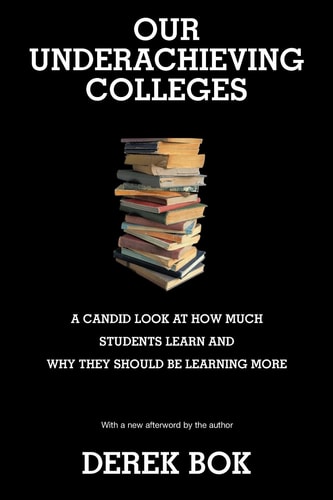
Our Underachieving Colleges: A Candid Look at How Much Students Learn and Why They Should Be Learning More
0
0
As an Amazon Associate and affiliate partner, Menrva Books earns from qualifying purchases. Learn more
Author Description
Drawing on a large body of empirical evidence, former Harvard President Derek Bok examines how much progress college students actually make toward widely accepted goals of undergraduate education. His conclusions are sobering. Although most students make gains in many important respects, they improve much less than they should in such important areas as writing, critical thinking, quantitative skills, and moral reasoning. Large majorities of college seniors do not feel that they have made substantial progress in speaking a foreign language, acquiring cultural and aesthetic interests, or learning what they need to know to become active and informed citizens. Overall, despite their vastly increased resources, more powerful technology, and hundreds of new courses, colleges cannot be confident that students are learning more than they did fifty years ago. Looking further, Bok finds that many important college courses are left to the least experienced teachers and that most professors continue to teach in ways that have proven to be less effective than other available methods. In reviewing their educational programs, however, faculties typically ignore this evidence. Instead, they spend most of their time discussing what courses to require, although the lasting impact of college will almost certainly depend much more on how the courses are taught. In his final chapter, Bok describes the changes that faculties and academic leaders can make to help students accomplish more. Without ignoring the contributions that America's colleges have made, Bok delivers a powerful critique--one that educators will ignore at their peril.
Menrva's Summary
THE THESIS
This book critically examines the effectiveness of contemporary higher education in fostering essential student learning outcomes. Drawing on extensive empirical evidence, former Harvard President Derek Bok investigates the actual progress college students make in areas such as writing, critical thinking, quantitative skills, and moral reasoning. He finds that despite increased resources and technological advancements, many students do not achieve the expected levels of improvement, and colleges struggle to demonstrate greater learning gains than in previous decades. The book also scrutinizes pedagogical practices, highlighting the underutilization of experienced teachers and less effective teaching methods, while faculties often overlook these issues in favor of curriculum discussions.
THE SCOPE MAP
- Analysis of student progress in core academic skills like writing and critical thinking.
- Evaluation of student development in quantitative skills and moral reasoning.
- Assessment of student gains in foreign language proficiency and cultural interests.
- Examination of how colleges are preparing students for active and informed citizenship.
- Critique of teaching methodologies and the role of experienced instructors.
- Discussion on the disconnect between faculty discussions and evidence-based teaching practices.
- Recommendations for academic leaders and faculties to enhance student learning outcomes.
THE AUTHORITY PERSPECTIVE
Derek Bok's 'Our Underachieving Colleges' offers a sobering critique of the American higher education system, based on a thorough review of empirical data. The book has been recognized for its rigorous analysis and its challenge to the status quo, prompting discussions among educators and policymakers about the true value and effectiveness of college degrees. Bok's findings suggest a need for significant reform in how colleges approach teaching and student development to ensure students are adequately prepared for the complexities of modern life and citizenship.
Page Count:
440
Publication Date:
2008-09-02
Publisher:
Princeton University Press
ISBN-10:
1400826985
ISBN-13:
9781400826988
Politics
Non-Fiction
Critical thinking
Higher Education
Education Policy
Community Tags
Similar Books