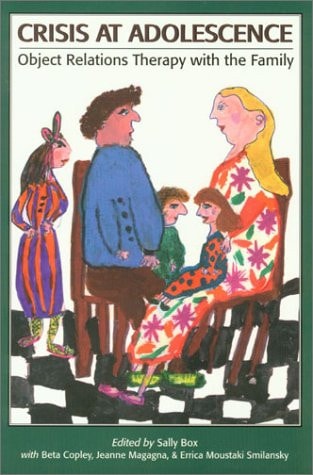
Crisis at Adolescence: Object Relations Therapy with the Family
0
0
As an Amazon Associate and affiliate partner, Menrva Books earns from qualifying purchases. Learn more
Author Description
This book is about work with adolescents and their families. It is based on a particular psychoanalytic understanding of the way people function and grow and on the development of a corresponding family therapy model. It includes throughout detailed examples to illustrate the interactions between therapists and family members together with the concepts used to understand and work with them. This volume presents an approach therapists can learn in order to make the most of their capacity to be in touch with their own and others' feelings as a major tool in the therapeutic work with families. Adolescence is viewed as epitomizing a transitional time when hard-won patterns of stability in the family - individually and as a group - are liable to break down. Hitherto denied and split-off feelings threaten to erupt and may cause disturbing changes of attitude and behavior. There is the danger of severe fragmentation but at the same time a chance to reintegrate the unmanageable aspects rather than deal with them via projection and acting out. However, the only way this can happen is if those split-off feelings and functions can be contained and integrated at a feeling level as well as at a verbal level. The authors describe a method that helps the family as a whole and as individuals to come to grips with the processes that are causing trouble, and to discover or rediscover previously disowned aspects of themselves. In this approach therapists represent and carry the functions and painful feelings that cannot otherwise be borne, such as madness, inadequacy or rejection, toward the possibility of their being made bearable and reintegrated. The model draws heavily on the concepts of Melanie Klein and her successors - particularly that of projective identification, the notion of the paranoid-schizoid and depressive positions, the work on narcissism and borderline states, and especially Bion's contributions to the processes of thinking and 'containment.'
Menrva's Summary
THE THESIS
This book investigates how object relations therapy can be applied to families with adolescents experiencing transitional crises. The authors, drawing on psychoanalytic theory, present a family therapy model designed to help individuals and families navigate the breakdown of established patterns during adolescence. They detail a method that enables therapists to contain and integrate difficult feelings and disowned aspects of the self, facilitating a reintegration of unmanageable emotions rather than their projection or acting out. The approach emphasizes the therapist's role in bearing painful feelings like inadequacy or rejection to make them bearable for the family.
THE SCOPE MAP
- Application of object relations theory to family therapy with adolescents.
- Detailed examples illustrating therapist-family interactions and conceptual understanding.
- Focus on containment and integration of split-off feelings and functions.
- Exploration of adolescence as a transitional period of potential family breakdown and reintegration.
- Therapist's role in representing and bearing difficult emotions for the family.
- Draws on concepts from Melanie Klein, projective identification, paranoid-schizoid and depressive positions, narcissism, borderline states, and Bion's work on thinking and containment.
THE AUTHORITY PERSPECTIVE
This work is presented as a psychoanalytically-informed approach to family therapy, specifically addressing the challenges of adolescence. The authors detail a therapeutic model that utilizes object relations concepts to help families manage emotional upheaval and reintegrate disowned aspects of the self. The book emphasizes the practical application of these theories through detailed case examples, aiming to equip therapists with tools for containing difficult feelings within the family system. Its theoretical underpinnings are rooted in the work of Klein, Bion, and their successors.
Page Count:
296
Publication Date:
1977-07-07
Publisher:
Jason Aronson, Inc.
ISBN-10:
1568210949
ISBN-13:
9781568210940
Non-Fiction
Psychology
Family Dynamics
Therapy
Community Tags
Similar Books









Reader Comments
Share Your Thoughts
No comments yet. Be the first to share your thoughts!