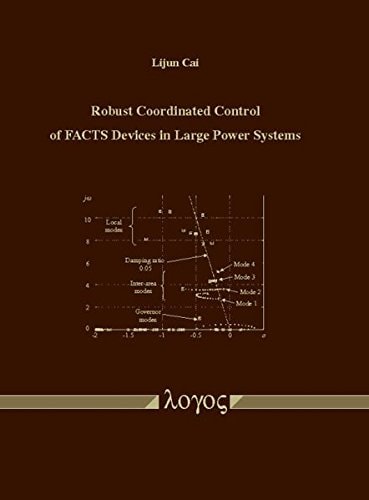
Robust Coordinated Control of FACTS Devices in Large Power Systems
0
0
As an Amazon Associate and affiliate partner, Menrva Books earns from qualifying purchases. Learn more
Author Description
With the rapid development of power electronics, Flexible AC Transmission Systems (FACTS) devices have been proposed and implemented in power systems. This research mainly investigates the robust coordinated control of FACTS devices and traditional power system controllers in large power systems. The following objectives have been achieved: FACTS modeling and controller design: FACTS devices are modeled using the current injection method. Linear and non-linear methods for the FACTS damping controller design are developed. Optimal choice and allocation of FACTS devices: Using the genetic algorithms, the locations of the FACTS devices, their types and rated values are optimized simultaneously. The objective function, which consists of the investment costs for FACTS devices and the generation costs, is minimized.Adaptive FACTS transient controller design using ANFIS technology: This objective deals with the development of fuzzy adaptive FACTS transient stability controller. Furthermore, by means of Adaptive Network based Fuzzy Inference System (ANFIS) technology, the fuzzy controller parameters are optimized.Simultaneous coordinated tuning of FACTS damping controller and conventional Power System Stabilizers (PSSs): Using the linearized power system model and the parameter-constrained non-linear optimization algorithm, interactions among PSS and FACTS damping controllers are considered. The controller parameters are optimized simultaneously to achieve a global optimal damping behavior.Robust FACTS loop-shaping Power Oscillation Damping (POD) controller design in multi-machine power systems: By applying the model reduction and modern robust loop-shaping control technique, the FACTS robust loop-shaping POD controller is realized. This controller exploits the advantages of both conventional loop-shaping and modern robust control technique. Moreover, it is a decentralized approach and suitable for FACTS controller design in real large power systems.
Menrva's Summary
THE THESIS
This research investigates the robust coordinated control of Flexible AC Transmission Systems (FACTS) devices and traditional power system controllers within large-scale power grids. The author, Lijun Cai, addresses key objectives including the modeling and design of FACTS damping controllers using both linear and non-linear methods, and the optimal selection and placement of FACTS devices through genetic algorithms to minimize investment and generation costs. Further research explores adaptive FACTS transient controller design using ANFIS technology for parameter optimization, simultaneous coordinated tuning of FACTS damping controllers and conventional Power System Stabilizers (PSSs) for global optimal damping, and the design of robust FACTS loop-shaping Power Oscillation Damping (POD) controllers using model reduction and robust control techniques for decentralized application in real power systems.
THE SCOPE MAP
- Modeling of FACTS devices using the current injection method.
- Development of linear and non-linear methods for FACTS damping controller design.
- Optimization of FACTS device locations, types, and rated values using genetic algorithms.
- Design of adaptive FACTS transient stability controllers utilizing ANFIS technology.
- Simultaneous coordinated tuning of FACTS damping controllers and conventional Power System Stabilizers (PSSs).
- Realization of robust FACTS loop-shaping Power Oscillation Damping (POD) controllers for multi-machine power systems.
THE AUTHORITY PERSPECTIVE
This work presents a detailed technical investigation into advanced control strategies for power systems, focusing on the integration and optimization of FACTS devices. The research outlines specific methodologies for controller design, device allocation, and coordinated tuning, suggesting a dense, specialist text aimed at engineers and researchers in the field of power systems control. The systematic approach to problem-solving and the application of optimization techniques indicate a rigorous academic contribution to the understanding and implementation of robust control in large power grids.
Page Count:
180
Publication Date:
2004-01-01
Publisher:
Logos Verlag Berlin
ISBN-10:
3832505709
ISBN-13:
9783832505707
Non-Fiction
Science & Technology
Electrical Engineering
Power Systems
Control Engineering
Optimization
Community Tags
Similar Books