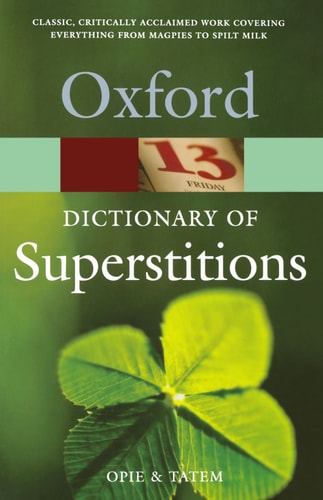
A Dictionary of Superstitions
0
0
As an Amazon Associate and affiliate partner, Menrva Books earns from qualifying purchases. Learn more
Author Description
Is it good or bad luck to mention a pig to a fisherman? What does it portend when you break a double-yolked egg? Or when you witness a headless shadow? How many frogs do you need to cure whooping cough? And what's all this about black cats?Ranging from the familiar to the bizarre, and including everything from spells and omens to rituals and taboos, this delightfully informative dictionary covers a wide array of popular superstitions, touching on virtually every aspect of human culture. They embrace family life and the lore of farmers, sailors, miners, and actors; offer advice on the signs to observe when contemplating a journey or a marriage; reveal the significance of animals, plants, stones, colors, food and drink, the elements, and heavenly bodies; outline the precautions to be taken after a death in the house or during a thunderstorm; and disclose the motives behind seasonal customs at New Year, in May, at Halloween, and Christmas. Each entry is arranged alphabetically according to its central idea or object, and illustrated with a selection of chronologically ordered quotations that indicate the history and development of each belief. And a thematic index helps the reader discover surprisingly coherent patterns in these mysterious and often misunderstood methods of comprehending the world and overcomingits perils, and shows the strong underlying connections with witchcraft and pagan religions.Superstitions have never before been treated in such depth or on such a scale. An entertaining volume for anyone curious about the beliefs of the past, A Dictionary of Superstitions also makes a valuable contribution to the study of folklore, providing the first systematic account of beliefs that form an integral part of our social life.
Menrva's Summary
THE THESIS
This volume investigates the historical origins, cultural significance, and evolution of popular superstitions within human society. The authors, Iona and Peter Opie alongside Moira Tatem, utilize extensive archival research and historical literary citations to construct a systematic taxonomy of beliefs. By organizing these entries alphabetically and providing chronological context, the work argues that superstitions function as a coherent, albeit complex, framework for navigating uncertainty and social life.
THE SCOPE MAP
What You Will Find
- An alphabetical dictionary of superstitions ranging from omens and rituals to taboos and folk remedies.
- Chronological quotations illustrating the historical development of specific beliefs.
- A thematic index connecting disparate superstitions to broader concepts like witchcraft and paganism.
Scope Limits
- The text focuses primarily on British and Western folk traditions rather than a global survey of all world superstitions.
- It does not provide psychological analysis of why individuals hold these beliefs, focusing instead on historical documentation.
THE AUTHORITY PERSPECTIVE
Scholars and folklorists recognize this work as a foundational reference text for the study of traditional beliefs. Readers frequently note the academic rigor of the citations while appreciating the accessibility of the entries for general interest.
Page Count:
512
Publication Date:
2005-12-08
Publisher:
Oxford University Press
ISBN-10:
0192806645
ISBN-13:
9780192806642
Mythology
Superstition
Reference
Folklore
Cultural History
Anthropology
Community Tags
Similar Books