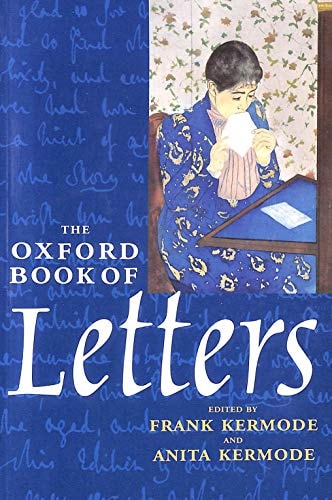
The Oxford Book of Letters
0
0
As an Amazon Associate and affiliate partner, Menrva Books earns from qualifying purchases. Learn more
Author Description
Reading other people's letters, like reading private diaries, offers thrilling and unexpected glimpses into the lives of others--their pledges of love and their sharp remonstrances, their thoughts on war and peace and the gossip of the day, their intellectual travels and idle chatter. It is partly this guilty pleasure we take in such literary eavesdropping that makes The Oxford Book of Letters so compelling. More than 300 letters spanning five centuries chronicle the affairs of correspondents from Elizabeth I to Groucho Marx, from politicans to poets, from the famous to the unknown.Editors Frank Kermode and Anita Kermode have chosen a remarkable selection of correspondents both educated and barely literate, with styles that range from polished and witty to stumbling and artless, but who all share a gift for letters that display an immediacy and intimacy not shared by any other form of writing. Here is John Adams to his wife, Abigail, in what we know to be a harried April of 1776 ("You justly complain of my short Letters, but the critical State of Things and the Multiplicity of Avocations must plead my Excuse--"); Benjamin Disraeli, confiding to Lady Bradford the secret of his purchase of the Suez Canal for England ("not one of the least events of our generation"); Charles Dickens to his son, Henry, regarding finances ("You know how hard I work for what I get, and I think you know that I never had money help from any human creature after I was a child"); Flannery O'Connor to Cecil Dawkins, a young college instructor, with writing advice ("You can't be creative in all directions at once. Freshman English would suit me fine. I'd make them diagram sentences"); and an indignant A.T. Harris to the head of the Atlantic City Railroad in 1896 ("On the 15th yore trane that was going to Atlanta ran over mi bull...yore ruddy trane took a peece of hyde outer his belly between his nable and his poker at least fute square"). Among the most moving letters are those from emigrants t
Menrva's Summary
THE THESIS
This collection investigates the historical and cultural significance of the personal letter as a primary medium for human expression and intimate communication. Editors Frank and Anita Kermode curate a vast selection of correspondence to demonstrate how the epistolary form captures the immediacy of lived experience across five centuries. By presenting a diverse array of voices, the authors argue that letters provide unique, unfiltered insights into the private lives and public concerns of individuals ranging from historical figures to ordinary citizens.
THE SCOPE MAP
What You Will Find
- A chronological selection of over 300 letters spanning five centuries of history.
- Correspondence from a wide spectrum of society, including monarchs, politicians, poets, and common laborers.
- Examples of varying linguistic styles, from highly polished prose to unrefined, colloquial writing.
Scope Limits
- The collection does not provide a comprehensive history of the postal system or the technical evolution of letter writing.
- The selection is limited to the editors' personal choices and does not represent an exhaustive archive of all significant historical correspondence.
THE AUTHORITY PERSPECTIVE
Critics and readers frequently note the accessibility and humanizing quality of the selected texts, which bridge the gap between historical figures and contemporary audiences. Scholars highlight this work as a valuable resource for understanding the evolution of personal communication and the enduring power of the written word.
Page Count:
592
Publication Date:
1996-10-17
Publisher:
Oxford University Press
ISBN-10:
0192825224
ISBN-13:
9780192825223
History
Non-Fiction
United States
Literature
Correspondence
Great Britain
Letters
Anthology
Community Tags
Similar Books