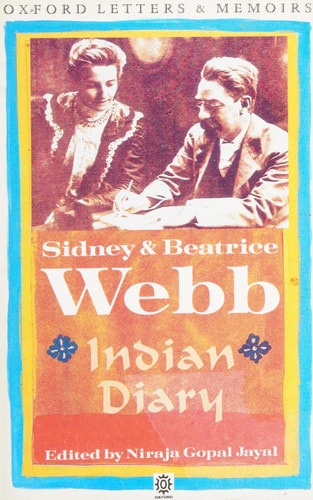
Indian Diary
0
0
As an Amazon Associate and affiliate partner, Menrva Books earns from qualifying purchases. Learn more
Author Description
Sidney and Beatrice Webb, the Fabian socialists who founded the London School of Economics and the New Statesman, traveled extensively in India for four months in 1911-12. During this period, they recorded their observations in a diary kept by Beatrice. Remaining virtually unnoticed for seventy-five years, the resulting Indian Diary did not appear in print for the first time until 1987.The Webbs surpass the writings of their near contemporaries, E.M. Forster and J.R. Ackerley, in sharpness of observation and range of interests. Along with the normal traveler's curiosity with historical sites and people, the Webbs reveal a serious interest in India's politics, religions, philosophies, and associated institutions. Upon arrival in India, they attend the twenty-sixth session of the Indian National Congress and meet political figures such as Gokhale, Tilak, Annie Besant, and C.F. Andrews. They stay with maharajas, nawabs, begums, other residents, and ICS officials. They visit madrassas and gurukulas, Arya and Brahmo Samajists, Mrs. Besant's College (now the Banaras Hindu University) in Banaras, and other learning institutions in Delhi and Poona. They camp in the hinterland with district officers in order to see the underside of imperial rule; watch feudalism in operation within the princely states; and travel to the Kumbh Mela at Allahabad to witness unfamiliar rituals and mass devotion. Niraja Gopal Jayal has provided a detailed introduction and helpful notes which clarify the Webbs' whereabouts during their journey. Indian Diary remains a work of both considerable documentary value and great literary charm.
Menrva's Summary
THE THESIS
This work investigates the socio-political landscape and institutional structures of British-ruled India through the observational lens of two prominent Fabian socialists. Beatrice Webb, a social reformer and co-founder of the London School of Economics, utilizes her personal diary to document a four-month expedition across the Indian subcontinent in 1911-1912. The text provides a systematic analysis of the intersection between imperial administration, indigenous political movements, and diverse religious practices during the twilight of the British Raj.
THE SCOPE MAP
What You Will Find
- Detailed accounts of meetings with key political figures including Gokhale, Tilak, and Annie Besant.
- Observations on the operations of princely states and the daily functions of district officers.
- Documentation of educational institutions, ranging from madrassas to the precursor of Banaras Hindu University.
- First-hand descriptions of cultural events such as the Kumbh Mela in Allahabad.
Scope Limits
- The text is limited to the specific four-month window of the Webbs' 1911-1912 visit.
- The narrative reflects the subjective, albeit analytical, perspective of two British intellectuals rather than a comprehensive historical survey of the era.
THE AUTHORITY PERSPECTIVE
Scholars and historians value this text for its sharp, analytical observations that distinguish it from the more impressionistic travel writing of the period. Readers frequently note that the diary serves as a significant primary source for understanding the administrative and social complexities of colonial India at the turn of the century.
Page Count:
270
Publication Date:
1990-09-13
Publisher:
Oxford University Press
ISBN-10:
0192827480
ISBN-13:
9780192827487
Biography
History
Colonialism
Travelogue
India
Community Tags
Similar Books