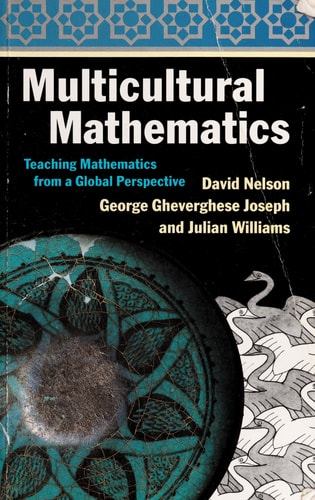
Multicultural Mathematics
0
0
As an Amazon Associate and affiliate partner, Menrva Books earns from qualifying purchases. Learn more
Author Description
The history of mathematics is one of creation and discovery in many parts of the world, and yet few people realize that Pythagoras' Theorem was known to the Babylonians a thousand years before the Greeks. Similarly, Pascal's Triangle of 1645 was actually used in practical ways much earlier in China. Indeed, there is a rich field of African, Middle Eastern, and Asian mathematics that is often ignored in the teaching of the subject. Mathematics, then, is an international language and field of study that knows no barriers between race, culture, or creed. How can we exploit this rich heritage not only to improve the teaching of mathematics, but to prepare our children for life in a multicultural society?This pioneering book is the first to explore ways of helping schoolchildren understand the universality of mathematics, and at the same time making it a more enjoyable, relevant, and rewarding enterprise. Multicultural Mathematics brings together the experience of three well-known teachers and researchers who offer suggestions and guidance for an important new approach to education. Written for parents, teachers, and administrators, and with technical mathematics kept to a minimum, this book discusses the theories behind multicultural mathematics, shows how this method can be applied within the core of any elementary curriculum, and explores the educational and social benefits of this new approach to teaching mathematics.
Menrva's Summary
THE THESIS
How can educators integrate the global history of mathematical discovery into elementary curricula to improve student engagement and foster multicultural awareness? The authors, drawing on their expertise in education and mathematical history, argue that mathematics is a universal human endeavor rather than a Western-centric discipline. They present a framework for educators and administrators to diversify the teaching of mathematical concepts by highlighting contributions from African, Middle Eastern, and Asian cultures.
THE SCOPE MAP
What You Will Find
- Historical evidence of mathematical concepts originating outside of Western traditions
- Pedagogical strategies for incorporating global history into elementary classrooms
- Theoretical justifications for multicultural approaches to STEM education
Scope Limits
- Does not provide advanced technical mathematical proofs or complex equations
- Does not offer a comprehensive global history of mathematics beyond its application in education
THE AUTHORITY PERSPECTIVE
Educators and administrators frequently cite this text as a foundational resource for diversifying mathematics curricula. Experts note that while the prose is accessible to non-specialists, it provides a significant shift in perspective for traditional classroom instruction.
Page Count:
240
Publication Date:
1993-08-19
Publisher:
Oxford University Press
ISBN-10:
0192822411
ISBN-13:
9780192822413
Pedagogy
Mathematics history
Mathematics
Education
Community Tags
Similar Books