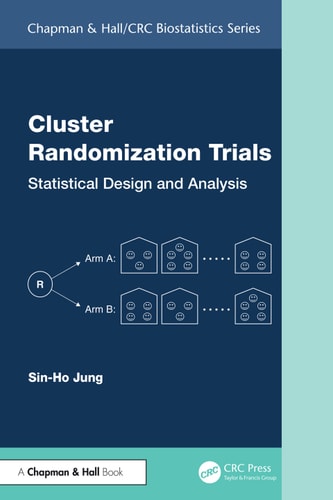
Cluster Randomization Trials
0
0
As an Amazon Associate and affiliate partner, Menrva Books earns from qualifying purchases. Learn more
Author Description
Oftentimes, small groups (called clusters) of individuals (called subunits) are randomized between treatment arms. Typically, clusters are families, classes, communities, surgeons operating patients, and so on. Such trials are called cluster randomization trials (CRTs). The subunits in each cluster share common frailties so that their outcomes tend to be positively correlated. Since clusters are independent, the data in two arms are independent in CRTs. In a clinical trial, multiple sites (such as teeth or ears) from each subject may be randomized between different treatment arms. In this case, the sites (subunits) of each subject (cluster) share common genetic, physiological, or environmental characteristics so that their observations tend to be positively correlated. This kind of trials are called subunit randomization trials (SRTs). In SRTs, dependency exists both within and between treatment arms. Individually randomized group treatment (IRGT) trials are composite of traditional independent subject randomization and CRTs. In an IRGT trial, the control arm is to treat patients individually, whereas the experimental arm is to treat patients using a group training, education, or treatment to increase the treatment effect by close interactions among patients. As a result, the outcome data of the control arm are independent as in traditional trials, but those in the experimental arm are correlated within each group (cluster) as in CRTs. Hence, two arms in IRGT trials have different dependency structures. Unlike standard CRTs, clusters of IRGT trials are usually organized after randomization. But statistically, they have identical statistical issues between the two types of trials, i.e., accounting for the dependency within each cluster. Although this book is entitled Cluster Randomization Trials, it covers all three types of trials (i.e., CRTs, SRTs, and IRGT trials) resulting in clustered data. For outcome variables of binary, continuous, and time-to-event types, we
Menrva's Summary
THE THESIS
This book investigates the statistical methodologies for analyzing data from cluster randomization trials (CRTs), subunit randomization trials (SRTs), and individually randomized group treatment (IRGT) trials. The author, Sin-Ho Jung, addresses the unique challenges posed by correlated data within clusters, a common feature in these trial designs where individuals or sites within a group share characteristics that influence outcomes. The book aims to provide a comprehensive framework for understanding and accounting for this dependency, crucial for accurate statistical inference in clinical research.
THE SCOPE MAP
- Detailed explanation of cluster randomization trials (CRTs) and their statistical implications.
- Coverage of subunit randomization trials (SRTs) where multiple sites from each subject are randomized.
- Analysis of individually randomized group treatment (IRGT) trials, which combine independent subject randomization with group-based interventions.
- Methods for handling correlated outcome data for binary, continuous, and time-to-event variables.
- Discussion of the dependency structures within and between treatment arms in different trial designs.
- Statistical issues arising from clustered data in clinical research.
THE AUTHORITY PERSPECTIVE
The book provides a detailed exploration of statistical methodologies for various cluster-based trial designs, including CRTs, SRTs, and IRGT trials. It addresses the critical issue of correlated data within clusters, which is fundamental to accurate analysis in these settings. The author's focus on handling binary, continuous, and time-to-event outcomes suggests a comprehensive approach for researchers and statisticians. The material presented is likely to be of significant interest to those involved in the design and analysis of clinical trials where group-level randomization is employed.
Page Count:
212
Publication Date:
2024-12-20
Publisher:
Taylor & Francis
ISBN-10:
1040194354
ISBN-13:
9781040194355
Non-Fiction
Science
Medical research
Statistics
Methodology
Biostatistics
Community Tags
Similar Books