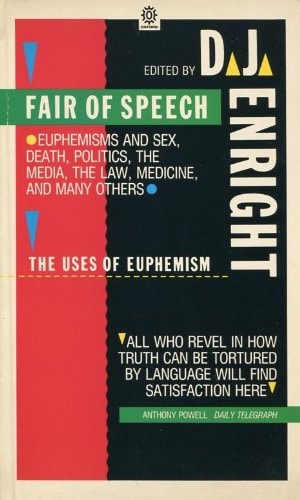
Fair of Speech: The Uses of Euphemism
0
0
As an Amazon Associate and affiliate partner, Menrva Books earns from qualifying purchases. Learn more
Author Description
Can a bomb ever be "clean"? Are we relieved to be warned that there will be an "odor" when once we were told that something would "stink"? Or when is a euphemism a mark of good taste and when is it a sign of verbal obfuscation? To answer such questions, Enright invited 16 distinguished writers to ponder and explore the ubiquitous phenomenon of euphemism. The result is a delightful and provocative collection that not only includes general reflections on euphemism and its history but also treats such specific categories as sex, death, and other natural functions; politics; the language of the great Christian texts; euphemisms spoken to and by children; the law; medicine; office life; and the jargon of official spokesmen, military communiques, and tyrants. Such writers as Diane Johnson, Robert Nisbet, John Gross, Robert Burchfield, and Joseph Epstein bring a variety of perspectives and sensibilities to bear on these topics. Because euphemisms are so intimate and integral to our thinking, any study of them is bound to throw light on the human condition, both past and present. Humor here jostles horror and the homely alternates with the farfetched. Taken together they form an eloquent and often amusing testament to the richness of the subject. Mother or maid? An introduction / D.J. Enright -- An outline history of euphemisms in English / Robert Burchfield -- Euphemisms in Greece and Rome / Jasper Griffin -- Soft soap and the nitty-gritty / Robert M. Adams -- Sex and euphemism / Joseph Epstein -- Euphemism and argot in France / Richard Cobb -- Euphemisms and children / Catherine Storr -- In the office / Jeremy Lewis -- Elizabeth Bennet's fine eyes / Patricia Beer -- Euphemisms and the media / Derwent May -- The law / David Pannick -- Do doctors mean what they say? / Diane Johnson and John F. Murray -- The religious speak-easy / Peter Mullen -- Politics / Simon Hoggart -- The state / Robert Nisbet -- Intimations of mortality / John Gross.
Menrva's Summary
THE THESIS
This collection investigates the social, political, and psychological functions of euphemism, questioning when the practice serves as a tool for clarity or a mechanism for obfuscation. Editor D.J. Enright assembles sixteen distinguished contributors to analyze how language is manipulated to soften reality, mask discomfort, or exert power. By examining diverse fields ranging from medicine and law to politics and domestic life, the authors provide a multi-faceted framework for understanding how euphemisms reflect the human condition.
THE SCOPE MAP
What You Will Find
- Historical analysis of euphemistic development in English, Greek, and Roman contexts.
- Thematic explorations of euphemism in sex, death, religion, and office environments.
- Critical examinations of jargon used by military, political, and medical institutions.
Scope Limits
- The text focuses primarily on Western linguistic traditions and English-language usage.
- It does not provide a comprehensive dictionary of euphemisms but rather a series of analytical essays.
THE AUTHORITY PERSPECTIVE
Critics and readers frequently note the accessibility of these essays, which balance academic rigor with wit and cultural observation. Experts highlight this work as a foundational, if eclectic, exploration of how linguistic choices shape societal perceptions of sensitive topics.
Page Count:
222
Publication Date:
1986-01-01
Publisher:
Oxford Univ Pr
ISBN-10:
0192830600
ISBN-13:
9780192830609
Non-Fiction
Communication
Sociology
Foreign Study
Language
Essays
Linguistics
Reference
Criticism & Theory