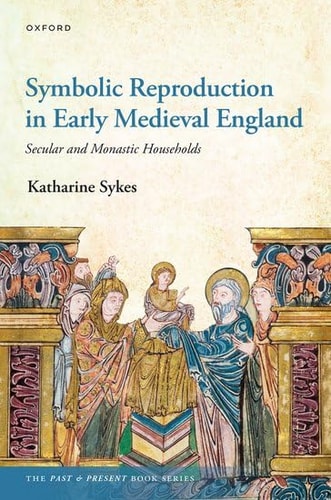
Symbolic Reproduction in Early Medieval England: Secular and Monastic Households
0
0
As an Amazon Associate and affiliate partner, Menrva Books earns from qualifying purchases. Learn more
Author Description
In the early Middle Ages, the conversion of the early English kingdoms acted as a catalyst for significant social and cultural change. One of the most visible of these changes was the introduction of a new type of household: the monastic household. These reproduced through education and training, rather than biological means; their inhabitants practised celibacy as a lifelong state, rather than as a stage in the life course. Because monastic households depended on secular households to produce the next generation of recruits, previous studies have tended to view them as more mutable than their secular counterparts, which are implicitly regarded as natural and ahistorical.Katharine Sykes charts some of the significant changes to the structure of households between the seventh to eleventh centuries, as ideas of spiritual, non-biological reproduction first fostered in monastic households were adopted in royal households in the tenth and eleventh centuries, and as ideas about kinship that were generated in secular households, such as the relationship between genealogy and inheritance, were picked up and applied by their monastic counterparts. In place of binary divisions between secular and monastic, biological and spiritual, real and imagined, Sykes demonstrates that different forms of kinship and reproduction in this period were intimately linked.
Menrva's Summary
THE THESIS
This work investigates how the early medieval English household evolved through the complex interplay between secular and monastic structures of reproduction. Katharine Sykes, a specialist in medieval social history, utilizes a comparative analysis of seventh- to eleventh-century records to challenge the traditional binary view of these institutions. She argues that monastic and secular households were not isolated entities but were instead mutually influential, sharing and adapting concepts of kinship, inheritance, and spiritual versus biological reproduction.
THE SCOPE MAP
What You Will Find
- Analysis of household structures in England from the seventh to the eleventh centuries.
- Examination of the transition from biological to spiritual reproduction models.
- Comparative study of royal and monastic kinship practices.
- Investigation into the application of genealogical inheritance within religious communities.
Scope Limits
- The study focuses primarily on the English context and does not provide a comprehensive survey of continental European monasticism.
- The analysis does not extend beyond the eleventh century.
THE AUTHORITY PERSPECTIVE
Scholars recognize this text as a significant contribution to the study of medieval social structures, particularly for its nuanced rejection of the rigid divide between secular and religious life. Readers frequently note the academic density of the prose, which is well-suited for researchers and students of early medieval history.
Page Count:
240
Publication Date:
2024-09-13
Publisher:
Oxford University Press
ISBN-10:
019284475X
ISBN-13:
9780192844750
History
Kinship Studies
Educational Resources
Early Medieval England
Europe
Social History
Cultural History
Monasticism
Community Tags
Similar Books