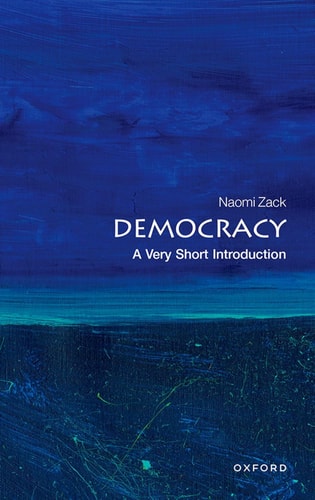
Democracy: A Very Short Introduction
0
0
As an Amazon Associate and affiliate partner, Menrva Books earns from qualifying purchases. Learn more
Author Description
Very Short Introductions: Brilliant, Sharp, InspiringDemocracy refers to both ideal and real forms of government. The concept of democracy means that those governed ― the demos ― have a say in government. But different conceptions of democracy have left many out. Naomi Zack provides here a fresh treatment of the history of this idea and its key conceptions. In the ancient world, direct and representative democracy in Athens and Rome privileged elites, as did democratic deliberative bodies in Africa, India, the Middle East, and China. Plato, Aristotle, and Cicero were sceptical of mob-rule dangers of democracy. The medieval and renaissance periods saw legislative checks on monarchy, notably the Magna Carta. The social contract theories of Thomas Hobbes, John Locke, and Jean-Jacques Rousseau matched political expectations that national government be based on consent, for the benefit of those governed. The American Revolution established a new sovereignty, based on British government tradition. By contrast, the French Revolution heralded universal humanitarian ideals.In the nineteenth century, Jeremy Bentham, John Stuart Mill, Immanuel Kant, and Karl Marx focused on the democratization of society. Mary Wollstonecraft had championed women's education and rights and Mill advocated further for that cause. Movements for the abolition of slavery, women's suffrage, and labour unionization were organized. World War II brought a reset in the twentieth century, with new democratic governments for many countries, including India and South Africa, and new ideals. Karl Popper, Hannah Arendt, and John Rawls emphasized orderly government transition, inclusion, and fairness. Equalitarian goals have concerned racial and ethnic minorities, as well as women. The twenty-first century has brought fresh challenges, including disasters and uninformed electorates. Democracy among nations is a future goal.ABOUT THE SERIES: The Very Short Introductions series from Oxford University Press conta
Menrva's Summary
THE THESIS
This book investigates the historical evolution, philosophical foundations, and contemporary challenges of democracy as both an ideal and a practical form of government. Naomi Zack, a professor of philosophy, utilizes a historical and analytical framework to trace the concept of the 'demos' from ancient civilizations to the modern era. She evaluates how various political theorists and social movements have shaped the definition of democratic participation and inclusion over time.
THE SCOPE MAP
What You Will Find
- Historical analysis of democratic structures in Athens, Rome, and non-Western societies
- Examination of social contract theories from Hobbes, Locke, and Rousseau
- Overview of nineteenth-century democratization movements including suffrage and labor rights
- Discussion of twentieth-century political philosophers such as Popper, Arendt, and Rawls
Scope Limits
- The text does not provide a comprehensive manual for modern policy implementation
- It does not offer an exhaustive legal analysis of specific contemporary national constitutions
THE AUTHORITY PERSPECTIVE
Experts recognize this work as a concise, accessible entry point for students and general readers interested in political theory. Readers frequently note the clarity of the prose, which manages to synthesize complex historical and philosophical developments into a brief, manageable format.
Page Count:
192
Publication Date:
2023-09-28
Publisher:
Oxford University Press
ISBN-10:
0192845063
ISBN-13:
9780192845061
Philosophy
History
Government
Democracy
Community Tags
Similar Books