Security and Policing of Sports Mega-Events: Security, Spectacle, and Camouflage in Rio de Janeiro
0
0
As an Amazon Associate and affiliate partner, Menrva Books earns from qualifying purchases. Learn more
Author Description
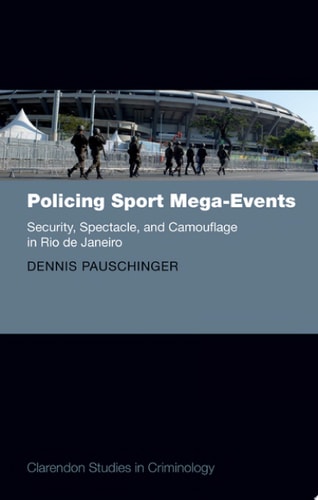
Security has become one of the most important aspects of sport mega-event organisation. This book explores how Rio de Janeiro was imagined and transformed into a security fortress when the 2014 Men's World Cup and the 2016 Olympics came to the city and how the fortress was nonetheless permeable and porous.Dennis Pauschinger experienced exceptional backstage access at high level in the Brazilian mega-event security architecture as well as at street level with the local public security sphere. His ethnographic account takes us from the hidden world of surveillance and control centres, to the security perimeters around stadiums, and to the mundane routine of police officers during day and night shifts at local police stations or at the Special Forces' headquarters.This book shows how police officers' emotions and Special Forces' war narratives impact the static and technology-based security models at mega-events and how traditional patterns of police work, along lines of class and racial inequalities, still prevail and shape the city's public security. The book argues against the common narrative of the positive impacts of mega-event security legacies upon host cities by advancing towards a general understanding of how security governance is carried out in places where the use of digital security technologies co-exists with overly lethal and repressive forms of policing.
Menrva's Summary
THE THESIS
This book investigates how the implementation of security infrastructures for sports mega-events in Rio de Janeiro transformed the city into a complex, permeable fortress. Dr. Dennis Pauschinger, utilizing his background in sociology and criminology, examines the intersection of high-tech surveillance and traditional, often repressive, policing methods. He argues that the security legacies of the 2014 World Cup and 2016 Olympics did not necessarily improve public safety but rather reinforced existing patterns of class and racial inequality within the urban environment.
THE SCOPE MAP
What You Will Find
- Ethnographic analysis of security governance in Rio de Janeiro during the 2014 World Cup and 2016 Olympics.
- Examination of the interplay between digital surveillance technologies and human-led police operations.
- First-hand accounts from both high-level security command centers and street-level police stations.
Scope Limits
- The study focuses specifically on the Brazilian context and may not account for security governance models in other global host cities.
- The research does not provide a comprehensive evaluation of the economic impacts of the events beyond their relation to security infrastructure.
THE AUTHORITY PERSPECTIVE
Experts in criminology and urban studies highlight this work as a significant contribution to the understanding of how mega-events reshape urban security landscapes. Readers frequently note the depth of the ethnographic research, which provides a rare, grounded perspective on the daily realities of police work in high-stakes environments.
Page Count:
288
Publication Date:
2024-01-01
Publisher:
Oxford University Press
ISBN-10:
0192848054
ISBN-13:
9780192848055
Sociology
Sports Studies
Criminology
Criminal Law
Security Studies
Urban Studies
Community Tags
Similar Books