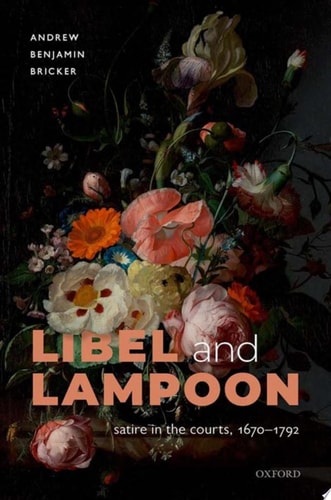
Libel and Lampoon: Satire in the Courts, 1670-1792
0
0
As an Amazon Associate and affiliate partner, Menrva Books earns from qualifying purchases. Learn more
Author Description
Libel and Lampoon shows how English satire and the law mutually shaped each other during the long eighteenth century. Following the lapse of prepublication licensing in 1695, the authorities quickly turned to the courts and newly repurposed libel laws in an attempt to regulate the press. In response, satirists and their booksellers devised a range of evasions. Writers increasingly capitalized on forms of verbal ambiguity, including irony, allegory, circumlocution, and indirection, while shifty printers and booksellers turned to a host of publication ruses that complicated the mechanics of both detection and prosecution. In effect, the elegant insults, comical periphrases, and booksellers' tricks that came to typify eighteenth-century satire were a way of writing and publishing born of legal necessity. Early on, these emergent satiric practices stymied the authorities and the courts. But they also led to new legislation and innovative courtroom procedures that targeted satire's most routine evasions. Especially important were a series of rulings that increased the legal liabilities of printers and booksellers and that expanded and refined doctrines for the courtroom interpretation of verbal ambiguity, irony, and allegory. By the mid-eighteenth century, satirists and their booksellers faced a range of newfound legal pressures. Rather than disappearing, however, personal and political satire began to migrate to dramatic mimicry and caricature-acoustic and visual forms that relied less on verbal ambiguity and were therefore not subject to either the provisions of preperformance dramatic licensing or the courtroom interpretive procedures that had earlier enabled the prosecution of printed satire.
Menrva's Summary
THE THESIS
This book investigates how the legal regulation of libel and the evolution of satirical writing mutually influenced one another in England between 1670 and 1792. Andrew Benjamin Bricker, a scholar of law and literature, examines how the lapse of prepublication licensing in 1695 forced authorities to rely on courtroom litigation to suppress dissent. He argues that the specific stylistic hallmarks of eighteenth-century satire—such as irony, allegory, and circumlocution—were direct responses to these legal pressures, prompting a cycle of innovation in both literary technique and judicial procedure.
THE SCOPE MAP
What You Will Find
- Analysis of the transition from prepublication licensing to post-publication libel litigation.
- Examination of literary techniques used to evade prosecution, including irony, allegory, and circumlocution.
- Study of the legal strategies used by booksellers and printers to avoid detection.
- Review of courtroom rulings that refined the interpretation of ambiguous language.
Scope Limits
- The study focuses primarily on English legal and literary history within the specified timeframe.
- It does not provide an exhaustive survey of all satirical works, focusing instead on those central to legal disputes.
THE AUTHORITY PERSPECTIVE
Scholars in the fields of legal history and eighteenth-century literature recognize this work as a significant contribution to understanding the intersection of censorship and creative expression. Readers frequently note the academic rigor of the prose and the depth of the archival research presented.
Page Count:
352
Publication Date:
2022-05-10
Publisher:
Oxford University Press
ISBN-10:
0192846159
ISBN-13:
9780192846150
History
Satire
Great Britain
Literary Criticism
Law
Media Studies
Eighteenth Century
Community Tags
Similar Books